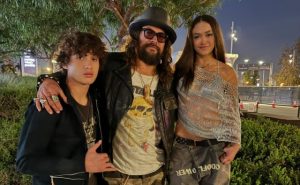
Jason Momoa’s appearance at Metallica’s All Within My Hands Helping Hands benefit was more than just a celebrity outing—it was a personal milestone, a moment in which the actor and father intentionally shifted the spotlight from himself to his children, Nakoa-Wolf and Lola. Surrounded by the deafening roar of the crowd and the signature, earth-shaking riffs of one of the most iconic metal bands in history, Momoa focused entirely on the experience through his kids’ eyes. The YouTube Theatre became a kind of private observatory for him, a space where the chaos of performing and producing, interviews, and global publicity receded in importance. Each guitar solo, each beat of Lars Ulrich’s drums, became secondary to the visible awe and excitement of his children. For fans who followed the event through photos and social media posts, the images captured a rare moment of domestic normalcy: relaxed hugs, goofy grins, and an almost meditative calm on the part of Momoa that only a fully present parent can truly exhibit.
The significance of the evening goes beyond the music itself. Momoa has frequently discussed how his childhood lacked consistent father figures, and how that absence shaped both his personal and professional life. In interviews, he has acknowledged that being a steady presence for his own children is a conscious priority, often guiding his choices around work schedules, locations for filming, and the pace at which he approaches fame and opportunity. Attending Metallica with Nakoa-Wolf and Lola was a deliberate expression of that philosophy: it wasn’t about giving them VIP access or celebrity perks, but about creating a moment of shared joy and emotional resonance that could linger long after the applause faded. This approach reframes celebrity parenting in a way that prioritizes emotional connection over status, illustrating how even figures accustomed to global attention find fulfillment in intimate, ordinary human experiences.
Photos from the concert reveal layers of nuance that words alone cannot capture. In the images, Momoa is seen crouching to meet his children at eye level, laughing at jokes, and gently guiding them through the ebb and flow of the crowd. Such gestures highlight not only his attentiveness but also the reciprocal nature of parent-child relationships: the children, thrilled by the spectacle, in turn ground him, tethering him to the immediacy of the moment rather than the ever-present pull of work obligations. Observers noted that the casual body language and genuine smiles offered a glimpse into a side of Momoa rarely portrayed in media coverage: a father completely absorbed in the simple joy of sharing something meaningful with his children. The rock concert, with all its volume and spectacle, becomes a backdrop for a deeply human narrative about presence, care, and familial bonding.
Beyond the individual experience, this evening underscores the broader role of music in family traditions and memory-making. Metallica’s songs, which have spanned decades and generations, act as cultural touchstones connecting parents and children in a shared auditory landscape. For Momoa, whose childhood experiences of fatherhood were marked by absence, the act of introducing his children to music that has shaped his own life carries profound symbolic weight. It represents continuity, resilience, and the transmission of identity across generations. The concert is thus transformed into a ritual: through the collective energy of the crowd, the visceral power of the music, and the intimate connection he fosters with his children, Momoa both honors the past and creates a living archive of experience that Nakoa-Wolf and Lola can carry forward.
Momoa’s choices around parenting, as reflected in moments like this, highlight the delicate balance celebrities must navigate between public visibility and private life. By framing the night as a family experience rather than a photo opportunity or headline-generating event, he prioritizes the relational over the performative. The concert is not just entertainment—it is a pedagogical act, a way of modeling curiosity, excitement, and attentiveness for his children. Every interaction, from explaining song meanings to joining in on chants, demonstrates that parenting is both intentional and performative, though in this case the performance is rooted in genuine emotion rather than the expectations of an audience. In a media landscape often dominated by curated images of wealth and status, this approach offers a more nuanced and authentic depiction of fatherhood.
Ultimately, the night at Metallica’s Helping Hands benefit becomes a story of subtle transformation and enduring memory. Momoa walks the line between the public and private self, yet chooses to center the private—his presence, his attentiveness, his joy in witnessing his children’s wonder. The experience illustrates how even the most high-profile individuals can prioritize relational depth over spectacle, turning moments of cultural consumption into lasting familial meaning. For Nakoa-Wolf and Lola, the concert is not merely a first exposure to a legendary band; it is a carefully curated moment of love, guidance, and connection, a memory that will outlast the music itself. In the end, Momoa’s evening serves as a reminder that parenthood, more than fame or accomplishment, is often measured in the small, intentional acts that leave indelible marks on the hearts of children.