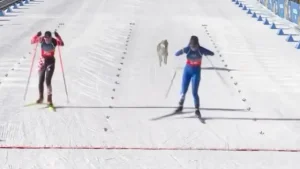
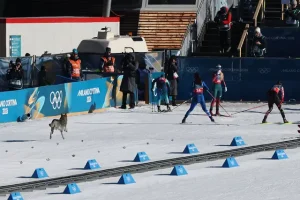
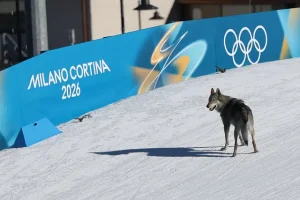
The 2026 Winter Olympics in Italy have already delivered memorable moments, but the latest incident at the cross-country skiing event may take the cake for unpredictability. In a sport known for endurance, precision, and focus, a dog unexpectedly entered the track, capturing the attention of athletes, spectators, and viewers around the world. Cross-country skiing, a long-distance winter sport that requires immense stamina and concentration, is traditionally free of outside distractions. Yet, on this occasion, a wolf-like dog named Nazgul made a surprise appearance, sprinting alongside competitors from Croatia and Greece as they crossed the finish line, leaving everyone from seasoned athletes to commentators scrambling to react. Footage of the event quickly circulated online, showcasing the canine weaving past skiers with playful energy, proving that even at an elite sporting event, the unexpected can steal the spotlight.
Athletes’ reactions varied widely, reflecting the unpredictable nature of the intrusion. Argentina’s Nahiara Gonzalez Diaz admitted her disbelief, saying, “I thought: What on earth is a dog doing here?” Her sentiment echoed the surprise felt by many as Nazgul bounded across the snow-covered track. Swedish skier Jonna Sundling described the encounter as “cute,” while Norwegian competitor Astrid Oyre Slind kept a sense of perspective, noting that facing a fellow athlete from Sweden remained a bigger concern than the four-legged gatecrasher. Other participants, however, expressed more cautious reactions, particularly those for whom safety on the track is paramount. Croatia’s Tena Hadzic admitted to initial fear, stating, “At first I thought it was a wolf, and that I was hallucinating because of the strenuous race.” The unexpected presence of such a large dog emphasized the potential hazards that unplanned animals could pose in high-speed, high-stakes competitions.
Nazgul’s presence, though disruptive, had a charming backstory. The dog had simply been searching for his owner, who later told Norwegian outlet VG that the pup “just disappeared” and “ran away from home.” Despite the interruption, the owner emphasized Nazgul’s gentle nature: “He is a very kind dog. Very stubborn, very sweet and very social. He always seeks contact with people. He doesn’t hurt people.” The canine’s human-like charisma made it almost impossible for spectators to be upset, even as ski experts highlighted the potential danger. Fredrik Aukland, a skiing analyst, warned that a loose animal on the track “could have been a disaster,” illustrating the delicate balance between amusement and risk at an event where fractions of a second can determine a medal.
Social media reactions reflected the duality of the moment—humor and concern intertwined. Many viewers embraced Nazgul’s appearance as a delightful diversion from the intensity of the Olympics. One user tweeted, “Cool Runnings! Enter that dog for French Winter Olympics 2030,” highlighting how the pup had captured public imagination as an underdog hero. Another commented, “Only at the Olympics do you get world-class athletes… and a random dog stealing the spotlight.” At the same time, cautionary voices reminded the public of the safety implications. Had the dog entered during a medal-deciding final, Aukland noted, the consequences could have been far more serious. For athletes competing at the highest level, even a well-meaning interruption has the potential to affect timing, focus, and personal safety.
Despite the potential hazards, many competitors found humor in the encounter. Greece’s Konstantina Charalampido, who finished last in the race, noted that Nazgul was “very well-behaved,” adding, “He followed the camera on the finishing straight, was cute, and thankfully didn’t disrupt the race. It was funny. He made me forget about the race, because it wasn’t good. Thanks to him, I’m famous now, so I have to thank him.” Her remarks highlight how, in certain circumstances, unexpected moments can become cherished memories, humanizing both athletes and spectators in an event often dominated by competition and results. Nazgul’s playful intrusion demonstrated that even at the Olympics, joy, spontaneity, and shared amusement have a place.
This incident is not the first time dogs have made appearances at the 2026 Winter Olympics. Earlier in the games, a hound wearing a Team USA jersey was spotted sitting courtside during figure skating, while another dog playfully interrupted a downhill ski race, slipping and sliding across the icy course. These moments underscore how unpredictable and entertaining the games can be, reminding audiences that the Olympics are not only a display of athletic excellence but also a stage for unexpected stories. While safety protocols are essential, moments like Nazgul’s sprint offer levity, viral appeal, and a reminder that sometimes, even elite sporting events are at the mercy of curiosity, chance, and a four-legged friend with boundless energy.
In conclusion, Nazgul’s appearance at the Winter Olympics cross-country skiing event has become one of the most talked-about incidents of the 2026 Games. The wolf-like dog’s chase across the finish line captured hearts, prompted laughter, and drew attention to both the unpredictability and humanity of competitive sports. Athletes’ reactions ranged from amusement to caution, reflecting the mixture of thrill and potential danger in unexpected disruptions. Social media amplified the moment, celebrating Nazgul as a canine hero, while ski experts reminded audiences of the importance of safety measures. For the athletes who encountered him, Nazgul became a brief but unforgettable part of their Olympic experience, and for viewers worldwide, he served as a reminder that even in the most disciplined and high-stakes settings, spontaneity, humor, and joy can emerge when least expected. The 2026 Winter Olympics, already full of memorable feats, now include one of its most unusual and endearing stories—a dog named Nazgul sprinting across history.