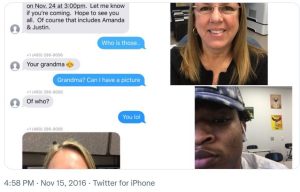
What began as an ordinary, easily forgotten texting mistake has grown into one of the most heartwarming Thanksgiving stories of the digital age. Nearly a decade ago, Wanda Dench, an Arizona grandmother, set out to send a familiar message to her grandson asking about plans for the upcoming holiday. It was the kind of warm, practical text millions of families exchange every year as Thanksgiving approaches—nothing unusual, nothing memorable. Yet a single misplaced digit sent that message to the wrong phone number, setting off a chain of events that would forever change two lives. Instead of reaching her grandson, the text landed with Jamal Hinton, a high school student in Phoenix. Confused but polite, he responded to ask who was messaging him. When Dench realized the mistake, she assumed the conversation would end there, another brief digital misfire quickly forgotten. But what followed proved that even the smallest errors can open the door to extraordinary human connection.
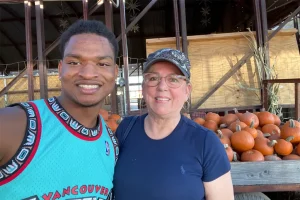
To clarify the confusion, Hinton asked Dench to send a photo so he could confirm whether she was indeed his grandmother. When she sent her picture, it became immediately clear that they were complete strangers. Under normal circumstances, this would have been the end of the exchange. Dench apologized, and the situation seemed resolved. But instead of letting the moment fade, Hinton replied with humor and curiosity. In a message that would later become iconic, he asked—half jokingly—whether he could still come over for Thanksgiving dinner and get a plate of food anyway. Rather than brushing off the comment, Dench responded with genuine warmth, telling him that he was welcome at her table. There was no calculation, no expectation of attention—just instinctive hospitality. When Thanksgiving Day arrived, Hinton decided to take her at her word. He showed up, unsure of what to expect, and was greeted not with awkwardness, but with sincerity, laughter, and an open seat at the table.
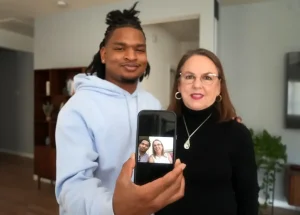
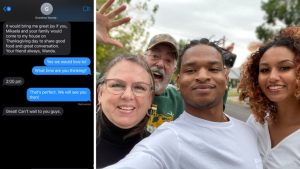
That first Thanksgiving could have remained a one-time feel-good story, but instead it became the foundation of a lasting friendship. Despite the age difference, different backgrounds, and unlikely circumstances of their meeting, Dench and Hinton discovered an easy comfort in each other’s company. They stayed in touch after the holiday, exchanging messages and updates about their lives. Over time, their bond deepened, shaped by mutual respect, humor, and consistency. As the years passed, they continued to reunite for Thanksgiving, turning an accidental invitation into an annual tradition. When Hinton later shared screenshots of their original text exchange on social media, the story quickly captured global attention. In an online space often dominated by division and negativity, their connection stood out as a reminder that kindness, openness, and a sense of humor can bridge even the widest gaps between strangers.
As public interest grew, what truly sustained the story’s appeal was its authenticity. Dench and Hinton did not allow the attention to overshadow their relationship. Interviews over the years consistently revealed that they viewed their bond as personal, not performative. For Dench, the friendship became a source of joy and gratitude, something she often described as meaningful beyond coincidence. She has spoken about believing that their connection happened for a reason, reinforcing her lifelong belief in kindness as a guiding principle. Hinton has echoed those sentiments, emphasizing that while it is gratifying to know their story brings happiness to others, the friendship itself is what matters most. Each Thanksgiving reunion reaffirmed that commitment. In a world where traditions often fade due to busy schedules or changing circumstances, their choice to keep showing up—year after year—became a powerful symbol of continuity and trust.
Over time, their annual Thanksgiving meal grew into something larger than a viral anecdote. It became a cultural symbol of generosity in an increasingly digital and impersonal world. Social media users eagerly awaited updates each year, finding comfort in the simple confirmation that the tradition was still alive. The story’s endurance set it apart from fleeting viral moments, demonstrating that kindness gains its power through consistency rather than spectacle. Their friendship also sparked broader conversations about technology’s role in human connection. While digital communication is often criticized for fostering distance, their experience showed how curiosity and warmth can transform even a wrong number into a meaningful relationship. Opportunities arose for them to share their message more broadly through interviews and collaborations centered on gratitude and togetherness, yet both remained careful to protect the heart of their tradition: sitting down together, sharing a meal, and honoring the spirit of that original invitation.
As the tradition approaches a full decade, Wanda Dench and Jamal Hinton’s story continues to resonate because of what it represents rather than how it began. It is a reminder that meaningful relationships do not always emerge from careful planning or long familiarity. Sometimes, they start with a mistake and grow through patience, humor, and an open heart. Each Thanksgiving serves as a quiet milestone—not marked by grand gestures, but by the simple act of showing up. In a time when many holiday traditions struggle to survive distance, division, or change, this one continues to thrive. Born from a wrong number and sustained by genuine care, it offers a powerful lesson: kindness does not need perfection to take root. When people choose generosity over indifference, even the smallest moments can grow into something lasting, meaningful, and deeply human—year after year.