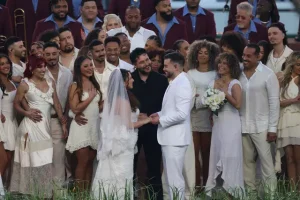
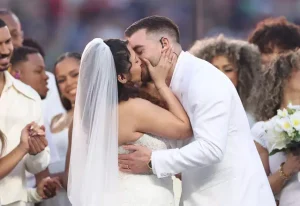
If you thought the bride and groom who joined Bad Bunny on the pitch at the Super Bowl were just part of the spectacle, there’s a heartwarming reason why they seemed so convincing. The couple dressed in full wedding attire during the halftime show weren’t acting; in fact, they genuinely tied the knot in front of millions of viewers around the world. While the New England Patriots and the Seattle Seahawks took a breather on the field, this extraordinary couple exchanged vows on one of the world’s biggest stages. Their union unfolded during Bad Bunny’s performance, which, despite receiving a scathing critique from former President Donald Trump who called it “absolutely terrible,” became a memorable celebration of love, music, and culture for fans in attendance and at home.
Sports fans who paid top dollar for a seat at Levi’s Stadium in California were treated not only to Bad Bunny’s high-energy set but also to an unforgettable wedding ceremony. Lady Gaga made a surprise appearance, Pedro Pascal could be seen dancing in the background, and the rapper delivered a medley of his hits, including fan favorites like “Tití Me Preguntó.” During this song, Bad Bunny was handed a ring, which he passed to the groom, who then acted out proposing to his bride. Cameras later showed the couple standing on a grand stage, surrounded by dancers and what appeared to be their wedding party, as a justice of the peace officiated. The ceremony culminated with the couple being pronounced husband and wife, sharing a kiss that left social media buzzing with speculation about whether the wedding was real—or just a performance.
A representative for Bad Bunny confirmed to Variety that the marriage was indeed authentic. During his performance of “BAILE INOLVIDABLE,” the newlyweds even cut their wedding cake and fed each other a piece, blending the celebration seamlessly with the show. NBC News journalist Rohan Nadkarni revealed that the couple originally invited Bad Bunny to their wedding, but due to his hectic schedule, he proposed an alternative: to host their wedding live during his Super Bowl halftime performance. Fans praised the Puerto Rican star for this incredibly generous gesture, calling the moment “pure magic” and “so cool,” noting how it showcased storytelling and authenticity in a spectacle usually reserved for theatrics.
The Super Bowl halftime show also included a touching interaction with a young boy, which initially sparked confusion among viewers. Many believed the child who received a Grammy from Bad Bunny was Liam Conejo Ramos, a five-year-old recently detained by ICE. In reality, the boy was child actor Lincoln Fox, who later shared on Instagram that being part of the performance was his “truest honor.” Some viewers speculated that Fox’s role symbolized Ramos or perhaps even a younger version of Bad Bunny himself, highlighting the artist’s penchant for embedding personal and political narratives within his performances. This combination of heartfelt moments and playful theatrics made the show feel both personal and globally resonant.
Bad Bunny’s performance was also laden with political and social messaging. Throughout the set, he clutched a football tightly, which featured the words “Together We Are America.” Meanwhile, a massive screen behind him displayed the phrase “the only thing more powerful than hate is love.” While many fans celebrated these gestures as unifying and inspiring, former President Donald Trump criticized the performance harshly, claiming it was “one of the worst ever” and disparaging both the music and choreography. Despite such critiques, the show received overwhelming praise online, with fans lauding Bad Bunny for blending artistry, inclusivity, and messages of unity in a space that reaches millions globally.
Financially, performing at the Super Bowl is unique: headlining artists do not receive a direct paycheck. Instead, the NFL covers production and performance expenses, while the exposure from performing in front of tens of millions worldwide provides significant career benefits. Past performers like Rihanna, Jennifer Lopez, Shakira, and The Weeknd saw massive increases in streaming numbers, social media followings, and concert ticket demand after their Super Bowl appearances. Bad Bunny, despite not receiving a paycheck, benefited similarly from the unparalleled visibility, combining entertainment with activism and personal storytelling, and solidifying his status as one of the most influential and socially conscious artists of his generation.
Finally, Bad Bunny’s halftime show was a culmination of his career, political advocacy, and cultural pride. Having won Album of the Year at the 2026 Grammys for DeBÍ TiRAR MáS FOToS, the first entirely Spanish-language album to achieve this honor, he used both stages to amplify messages about immigration, unity, and social justice. Throughout his career, he has been an outspoken critic of US policies, particularly regarding Puerto Rico and ICE, and his Super Bowl performance continued this narrative while celebrating love, community, and cultural pride. By combining a real-life wedding, surprise celebrity guests, and poignant social commentary, Bad Bunny created a halftime show that was not only entertaining but deeply meaningful, leaving fans, critics, and viewers alike talking long after the final whistle.