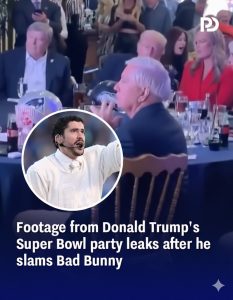
Telling footage from Donald Trump’s Super Bowl LX watch party has added a new layer to an already heated cultural conversation, revealing a striking contrast between public condemnation and private viewing. While the former president took to social media to sharply criticise Bad Bunny’s halftime performance, clips shared online show that the very same show played prominently on large screens inside his Mar-a-Lago gathering. The moment was not framed as a political statement or a spectacle, but its symbolism was impossible to ignore. For many observers, the footage suggested a disconnect between rhetoric and reality, sparking debate about authenticity, messaging, and the performative nature of outrage in the modern media age. The Super Bowl, long positioned as both a sporting and cultural event, once again became a mirror reflecting broader tensions in American public life.
The game itself provided a clear and decisive outcome, with the Seattle Seahawks defeating the New England Patriots 29–13 at Levi’s Stadium in Santa Clara, California. Yet, as is often the case, the football action quickly became secondary to the halftime show, which remains one of the most scrutinised stages in global entertainment. Bad Bunny’s performance was historic by any measure. As the first male solo Latin and Spanish-speaking artist to headline the Super Bowl halftime show, he delivered an eight-song set that blended spectacle, cultural pride, and mainstream appeal. Featuring hits such as “Tití Me Pregunto” and “MONACO,” along with a surprise appearance from another major star, the performance marked a milestone not just for the artist, but for representation on one of the world’s largest platforms.
Despite the significance of the moment, reaction to the show was deeply divided. Supporters praised Bad Bunny’s energy, global influence, and the visibility given to Latin culture, while critics framed the performance as alienating or inappropriate for the event. Among the most vocal detractors was Donald Trump, who issued a lengthy and forceful statement on Truth Social. In it, he described the halftime show as “one of the worst ever,” calling it a “slap in the face” to American values and questioning its language, choreography, and suitability for younger viewers. His post blended cultural critique with familiar political language, touching on topics ranging from national identity to the NFL’s kickoff rules, reinforcing how the halftime show had become a proxy battleground for wider ideological debates.
What made the criticism particularly notable was Trump’s absence from the stadium itself. Citing the distance of Santa Clara, California, as a reason for not attending, he instead hosted a Super Bowl watch party at his Mar-a-Lago resort in Florida. It was from this setting that the now-viral footage emerged. Shared by political commentator accounts online, the clips show guests watching Bad Bunny’s halftime show on large screens, seemingly engaged rather than dismissive. To critics, this moment undermined Trump’s public stance, suggesting hypocrisy or at least inconsistency. To supporters, it was dismissed as inconsequential background programming. Regardless of interpretation, the footage became part of the story, illustrating how visual evidence can reshape narratives in ways written statements cannot.
The backlash did not stop with Trump. Social media personality Jake Paul also condemned the performance, claiming he turned it off and urging viewers to do the same. His comments escalated quickly when he referred to Bad Bunny as a “fake American,” a remark that drew widespread criticism and reignited long-standing misunderstandings about Puerto Rican citizenship. The response was swift, including from within his own family. Logan Paul publicly distanced himself from his brother’s comments, affirming that Puerto Ricans are American citizens and expressing support for their opportunity to showcase talent on such a global stage. The exchange highlighted how quickly cultural commentary can veer into personal and political territory, forcing public figures to clarify positions in real time.
Perhaps the most powerful rebuttal came from boxer Amanda Serrano, whom Jake Paul has promoted for years. Serrano, a proud Puerto Rican and American citizen, issued a measured but firm response defending her identity and community. She emphasised Puerto Rico’s contributions to the United States across countless fields and rejected any framing that questioned their legitimacy. Her statement struck a balance between gratitude for professional support and an unwavering stance on respect and representation. In the end, the controversy surrounding Bad Bunny’s halftime show became about far more than music. It exposed ongoing tensions around identity, patriotism, and who gets to define “American” culture. And, as the footage from Mar-a-Lago quietly circulated, it reinforced a familiar truth of the modern era: actions, even unintentional ones, often speak louder than words.
https://x.com/patriottakes/status/2020712772556972386?s=20