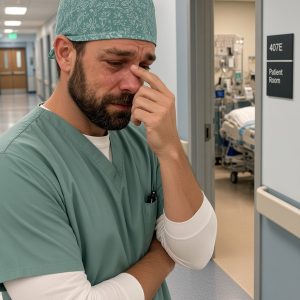
When I woke from the coma, I expected relief to come quickly, as if consciousness alone meant I was finished with danger. Instead, the doctors told me my body needed more time, that my brain had endured trauma it could not simply shake off. Two more weeks followed, spent in a hospital room that never truly slept. Days dissolved into one another under relentless fluorescent lights, measured only by medication cups, blood pressure cuffs, and the steady mechanical breathing of machines that seemed to watch me even when no one else did. My body felt heavy and unreliable, as though it belonged to someone else. My thoughts drifted in and out, slow and fogged, and loneliness pressed in hardest at night. The walls felt too close, the silence too loud, and the darkness carried a weight that made it hard to breathe. I didn’t yet know that those nights would soon be marked by something unexpected, something that would quietly reshape my understanding of survival.
Every night, without exception, at exactly eleven o’clock, a woman in scrubs entered my room. She never checked my vitals or adjusted the monitors. She never asked how I was feeling or glanced at my chart. She simply pulled the chair close to my bed, sat down, and began to talk. Always for thirty minutes. Not a second more, not a second less. Her voice was calm and unhurried, as if she existed outside the rhythm of the hospital entirely. She spoke about ordinary things: her garden, where tomatoes stubbornly leaned toward the ground while basil flourished effortlessly; her daughter’s piano recital, where one nervous mistake always crept in; her mother’s lemon cake, describing in loving detail how the zest had to be rubbed into sugar by hand to release its scent. These were not dramatic stories, just slices of life, gentle and unassuming. Often I didn’t have the strength to respond, but I listened with a kind of hunger. Those half hours became an anchor. The machines faded into the background, the sterile smell softened, and the room felt less like a cage and more like a place where I could rest.
On my final night in the hospital, as she stood to leave, something compelled me to speak. I asked her name. She smiled, squeezed my hand with a tenderness that felt deeply personal, and said only, “You’ll be okay now, sweetheart.” Then she walked out. The next morning, while waiting for discharge paperwork, I asked the head nurse if she could pass along my thanks to the woman from the night shift who had been sitting with me. The nurse frowned and pulled up the shift logs, scanning the screen carefully. She checked again, then once more, her expression tightening each time. When she looked back at me, her voice was cautious. She told me no one matching that description had worked nights that month. Panic stirred in my chest. I insisted it was impossible, that the woman had been there every night, in my room, at eleven. The nurse hesitated, excused herself, and returned twenty minutes later with someone else. The woman stood beside her, but she wasn’t wearing scrubs anymore. She wore a pale blue patient gown, her posture smaller, her hands twisting the fabric nervously. This was Beth, the nurse explained. A patient. Someone who had been sneaking out of her room at night. No one knew how she’d gotten a uniform.
I stared at Beth, my heart racing, and asked why she had visited me. She couldn’t meet my eyes. Shame and fear were written across her face. The nurse encouraged her gently, then stepped out, leaving the door ajar. Beth sat in the same chair she had occupied night after night and spoke so softly I had to strain to hear her. The uniform, she explained, had belonged to her daughter. Her name was Sarah, and she had been a nurse on that very floor. She had died a little over a year earlier. The weight of grief in Beth’s eyes made everything suddenly clear. This wasn’t deception or something eerie. It was loss. Raw, aching loss. Sarah had loved her job, Beth said. She believed that sometimes all people needed was a voice in the dark, someone to remind them they weren’t alone. Beth kept Sarah’s uniform in her bag, still scented faintly with hospital soap and her daughter’s perfume. She was in the hospital herself for heart tests, stress-related, they said. At night, the quiet became unbearable. Wearing the uniform felt like wearing her daughter’s strength. When she heard about me—the man in room 412 who wasn’t expected to survive—she looked in and saw someone who reminded her of the moment she lost Sarah. So she sat. And talked. She told me the things Sarah loved. The life she lived. Passing it on, as if it mattered that someone else carry it forward.
Suddenly, every story she had shared snapped into place. The garden had been Sarah’s. The piano recital belonged to Sarah’s daughter. The lemon cake was Sarah’s favorite. Beth hadn’t been filling silence. She had been preserving a life. I thanked her, and she smiled faintly, admitting that she thought she needed it too. As we sat there, a memory stirred in me—blurred but persistent. A hand holding mine. A voice cutting through pain, telling me to hold on because help was coming. I mentioned my accident, near Oak Street, and Beth’s eyes widened. She told me she had been there, driving home from a support group. She had seen the wreck and held my hand until the ambulance arrived. In that moment, the memory sharpened completely. It had been her all along. Not a nurse. Not a paramedic. A grieving mother who refused to let a stranger die alone. When I was discharged two days later, I didn’t walk away from that connection. I visited Beth daily, brought her a tomato plant, played piano music for her, and sat with her the way she had sat with me. I met her granddaughter, Lucy, who hugged me and claimed me as Grandma Beth’s hospital friend.
Weeks later, the three of us stood in Beth’s kitchen, baking lemon cake from a worn recipe card, flour dusting our hands and laughter filling the air. Grief was still present, lingering quietly in the background, but so was life. In all of this, I learned something essential. Healing is not only medicine or time. It is presence. It is the willingness to sit with someone in the dark, even when you are hurting too. Sometimes the person who saves you on the side of the road is the same one you are meant to help move forward. Kindness moves in circles, returning in forms you never expect. And sometimes survival isn’t the miracle at all. Connection is.