The Swedish man did not expect his post-divorce housing decision to become a quiet turning point in his life. In 2020, after separating from his wife, he made what felt like a practical and emotionally neutral choice: he left the spacious suburban family home to his ex-wife and children and purchased a compact studio-style apartment in the city. At the time, the move felt temporary, almost provisional. The apartment was small, efficient, and unassuming—exactly what he believed he needed while recalibrating his life. His intention was straightforward: live modestly, keep expenses low, pay off the loan as quickly as possible, and eventually move into something larger once life stabilized. Friends and family assumed the same. The idea of a grown man settling permanently into a tiny apartment after years of family living seemed unlikely, if not undesirable. Yet from the moment he began settling into the space, something unexpected happened. The apartment did not feel like a downgrade. Instead, it felt calm, manageable, and quietly empowering. What initially appeared to be a compromise soon revealed itself as a deliberate and deeply satisfying way of living.
As the months passed, his relationship with the space began to shift. What he once viewed as “small” started to feel intentional. Every square meter served a purpose, and nothing existed without reason. The apartment was divided into clearly defined zones that flowed naturally into one another, creating the impression of a complete home rather than a cramped stopgap. There was a sleeping area that felt private and restful, a living space that invited relaxation, and a compact kitchen that proved surprisingly capable. A dedicated work area allowed him to focus during the day without encroaching on the rest of his life. Rather than feeling boxed in, he experienced a sense of cohesion—each part of the apartment supporting the others. The absence of excess became a relief. He noticed how much easier it was to clean, to organize, and to maintain both the space and his mental clarity. Over time, he stopped thinking about upgrading. The question was no longer “When will I leave?” but “Why would I?”
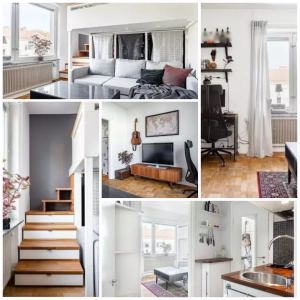
One of the most impressive aspects of the apartment was how intelligently it handled storage, an area where small spaces often fail. Instead of bulky wardrobes or cluttered corners, storage was integrated seamlessly into the architecture itself. The staircase, for example, was not just a way to move vertically but a multifunctional design element. Each step concealed a drawer or compartment, offering discreet storage for everything from shoes to seasonal items. This approach eliminated the need for visible clutter while preserving the apartment’s open, airy feel. Shelving units were thoughtfully placed throughout the home, each assigned a clear function. Clothing, personal items, and everyday essentials all had their own designated space. The result was an apartment that felt orderly without being sterile, personal without being chaotic. Visitors often remarked that the apartment felt larger than it was, a testament to how good design can reshape perception.
The dining area became one of the most surprising highlights of the home. Despite the limited square footage, he carved out a space that felt warm and intentional rather than improvised. Soft lighting, carefully chosen furniture, and a balanced layout transformed it into a place meant for slowing down. Meals were no longer rushed or eaten distractedly. Instead, the dining area encouraged presence—quiet breakfasts, thoughtful dinners, and the occasional long conversation with guests who quickly forgot they were sitting in a small apartment. This space became symbolic of the broader shift in his life: a move away from accumulation and toward appreciation. The apartment didn’t ask him to sacrifice comfort; it simply redefined what comfort looked like.
The kitchen further challenged assumptions about what small living requires. Compact but fully equipped, it contained everything he needed without excess. Appliances were chosen for functionality rather than size, and their streamlined arrangement made cooking feel intuitive rather than restrictive. Counter space was optimized, storage was vertical rather than sprawling, and nothing felt wasted. Guests who expected a cramped, inconvenient setup were consistently surprised by how usable and welcoming the kitchen felt. It became clear that the issue with small spaces is rarely size alone—it is poor planning. Here, every design choice worked in harmony, proving that thoughtful organization can rival square footage.
In the end, what began as a temporary solution evolved into a long-term philosophy. The tiny apartment became more than a place to live; it became a reflection of a changed mindset. By embracing minimalism and intentional design, he discovered that living with less did not mean living without. Instead, it offered clarity, freedom, and a renewed sense of control. The apartment challenged deeply ingrained assumptions about success, comfort, and space. It showed that downsizing does not have to feel like loss—it can feel like arrival. In choosing to stay, he didn’t just accept small living; he redefined it, proving that a well-designed, thoughtfully lived-in space can be more than enough.