In recent weeks, a controversial Immigration and Customs Enforcement (ICE) operation in and around Minneapolis has reignited a fierce national debate over immigration policy, enforcement practices, and the treatment of children caught in federal actions. What began as a localized enforcement effort quickly escalated into a national flashpoint as reports emerged that ICE agents had detained multiple children from the same school district in the suburb of Columbia Heights. These revelations struck a nerve across the country, touching on long-standing anxieties about family separations, the role of federal authorities in local communities, and the moral boundaries of immigration enforcement. At the center of the uproar is the case of five-year-old Liam Conejo Ramos, whose detention alongside his father provoked intense backlash from educators, parents, civil rights advocates, and lawmakers. As images and firsthand accounts circulated, the story became emblematic of broader concerns about how immigration laws are applied and who bears the greatest burden of those policies. The controversy deepened when Vice President JD Vance, a senior figure in the Biden administration, publicly weighed in, defending federal actions and urging local officials to cooperate with ICE. His remarks intensified an already polarized conversation, pushing immigration enforcement once again to the forefront of national political discourse.
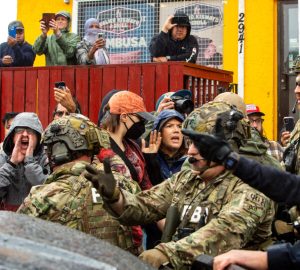
The enforcement operation itself unfolded against a tense and emotionally charged backdrop. Over several weeks, federal immigration agents increased their presence throughout the Minneapolis–Saint Paul metropolitan area, focusing on individuals suspected of being in the United States without lawful immigration status. This surge followed a dramatic and tragic incident on January 7, when a federal agent shot and killed a local resident, Renee Good, during clashes between ICE officers and community members. That shooting sparked protests, investigations, and heightened distrust between residents and federal authorities. Within this climate of fear and anger, reports surfaced that ICE officers were detaining people near homes, neighborhoods, and schools. Columbia Heights Public Schools Superintendent Zena Stenvik publicly stated that agents had been “circling our schools, following our buses, coming into our parking lots and taking our kids,” a description that sent shockwaves through the education community. Families reported seeing unmarked vehicles near school grounds, while teachers described students arriving to class visibly shaken and distracted. According to district officials, at least four children from the same school system were detained in recent weeks, despite posing no threat to public safety. These accounts fueled accusations that ICE’s tactics were unnecessarily aggressive and deeply harmful to children and families already living under immense stress.
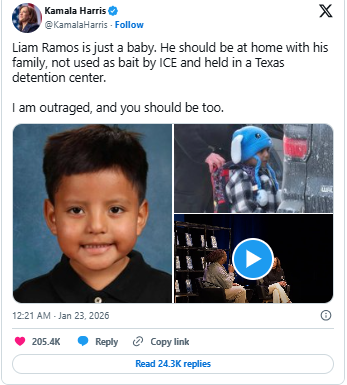
The most widely reported and emotionally charged incident involved five-year-old Liam Conejo Ramos. On January 20, shortly after returning home from preschool, Liam was detained along with his father, Adrian Alexander Conejo Arias. School officials and community members described a scene that quickly became a symbol of the controversy. According to their accounts, federal agents approached the family’s residence in the afternoon, detained the father outside the home, and then took Liam into custody, even though another adult was present and willing to care for him. Some witnesses and local leaders went further, alleging that agents used the young child to knock on the family’s door as part of their enforcement procedure. This claim, whether fully accurate or not, ignited intense outrage nationwide, as critics argued that involving a child so young in an enforcement action crossed a moral line. Liam and his father were subsequently transferred to a family detention facility in Texas, more than a thousand miles from their Minnesota community. The distance, combined with the boy’s age and vulnerability, transformed his case into a powerful symbol of what critics describe as the human cost of immigration enforcement.
Federal officials, however, have strongly disputed key elements of the narrative presented by local school leaders and community members. Spokespeople for the Department of Homeland Security and ICE offered a different account of events, emphasizing that the father, not the child, was the target of the enforcement action. According to DHS, Adrian Conejo Arias was in the United States without legal authorization, prompting agents to attempt his arrest. Officials claim that when agents approached, the father fled, leaving the child in or near a vehicle. In this version of events, officers remained with the child solely to ensure his safety and later took him into custody alongside his father to keep the family together. DHS officials also stated that they attempted to identify relatives or caregivers who could assume responsibility for the child but ultimately kept him with his family. They categorically denied that the child was ever a target of enforcement or that agents acted improperly, stressing that ICE policy does not focus on children. Despite these explanations, local officials, family representatives, and community advocates continue to challenge the federal account, insisting that adults were present and capable of caring for Liam and that ICE refused to allow alternative arrangements.
Liam’s case was not an isolated incident, which further intensified community alarm. Columbia Heights school officials confirmed that at least four students had been taken into ICE custody in recent weeks, including a ten-year-old elementary student and two seventeen-year-olds, one apprehended while traveling to school and another at a residence. These detentions have left families reeling, with parents describing children who now struggle with anxiety, fear, and confusion. Teachers report that students openly worry about whether they or their parents might be taken next, disrupting both attendance and learning. Superintendent Stenvik described meeting the detained five-year-old’s mother near the family home, recalling her visible distress and disbelief that her family was being treated as criminals despite reportedly following immigration procedures. Legal counsel for Liam’s family has reinforced this point, asserting that the family was lawfully seeking asylum and actively participating in immigration proceedings. For advocates, these cases underscore what they see as a disconnect between the stated goals of enforcement and the real-world consequences for children who have committed no wrongdoing.
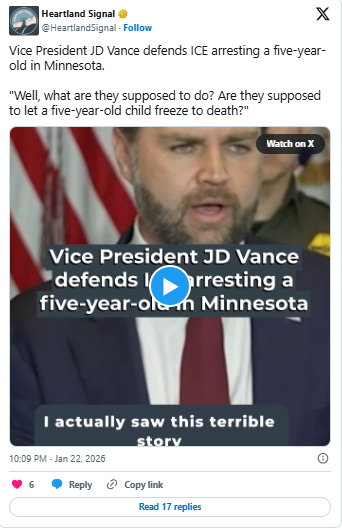
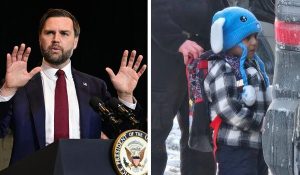
The controversy escalated further when Vice President JD Vance addressed the situation publicly during a visit to Minneapolis. His remarks placed responsibility for the unrest largely on local officials, whom he accused of failing to cooperate with federal law enforcement. According to Vance, resistance from city leaders created a chaotic environment that complicated enforcement efforts, contrasting Minneapolis with cities like Los Angeles and Chicago, which he suggested experienced fewer problems due to greater cooperation. When asked directly about the five-year-old’s detention, Vance acknowledged the emotional reaction many parents felt upon seeing images of the child but emphasized his reliance on the facts as presented by ICE and DHS. He argued that the child was not formally arrested but was taken into custody for his own safety after his father fled. Framing the issue starkly, Vance asked rhetorically whether agents were supposed to abandon a young child in dangerous conditions or refrain from arresting someone he described as an illegal immigrant. His comments crystallized the administration’s position: that enforcing immigration law is a necessary function of government, even when it produces painful and controversial outcomes.
At its core, the debate surrounding the Minneapolis ICE operations reflects deep and enduring divisions in American politics over immigration, child welfare, and federal authority. Democrats, civil rights groups, and immigration advocates have condemned the detentions as inhumane, particularly given claims that some families were lawfully pursuing asylum. They argue that enforcement practices must account for the psychological and emotional well-being of children, warning that trauma inflicted at a young age can have lifelong consequences. Republicans and administration officials counter that the rule of law must be upheld consistently and that exempting individuals from enforcement because they have children undermines the integrity of the immigration system. The presence of heavily armed federal agents near schools has heightened tensions, raising questions about school safety and the role of educational spaces as sanctuaries for children. As protests, legal challenges, and calls for congressional oversight continue, the fate of families like Liam’s remains central to a broader national reckoning. Whether viewed as a necessary assertion of legal authority or a troubling example of overreach, the events in Minnesota have forced the nation to confront how it balances law enforcement with compassion, and how far it is willing to go when the lives of children hang in the balance.