Donald Trump has long stood as one of the most polarizing figures in modern American political life, admired fiercely by his supporters and criticized relentlessly by his detractors. His outspoken manner, disregard for traditional political norms, and frequent controversies have ensured that nearly every public appearance draws intense scrutiny. This deep national divide was starkly illustrated during his recent visit to a Ford manufacturing facility in Dearborn, Michigan, where a confrontation with a heckler escalated into a moment emblematic of the broader tensions surrounding his public persona.
The setting for the incident was Ford’s River Rouge complex, a vast and historically significant manufacturing hub that represents the industrial roots of the United States. For decades, the plant has symbolized American labor, innovation, and economic strength, employing thousands and producing vehicles recognized worldwide. Trump arrived at the facility on a cold Tuesday morning, wearing a black peacoat and walking the factory floor with the intention of addressing workers about domestic manufacturing and policies he claimed revitalized American industry during his presidency. The visit was meant to project solidarity with working-class Americans and highlight economic nationalism.
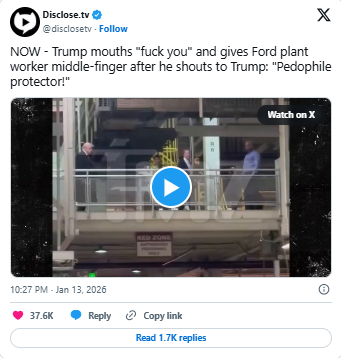
What began as a routine appearance quickly turned confrontational. Amid the gathered workers, one individual shouted a sharp and inflammatory accusation, labeling Trump a “pedophile protector.” The remark appeared to reference Trump’s past social connections with Jeffrey Epstein, the disgraced financier accused of sex trafficking minors, as well as Trump’s comments and actions regarding the release of Justice Department files connected to Epstein’s case. The accusation cut through the factory noise and drew immediate attention from those present.
Video footage of the moment shows Trump standing on an elevated walkway overlooking the factory floor. Initially composed, his expression changed rapidly as he reacted to the insult. Witnesses described a sudden spike in tension as Trump pointed toward the heckler and mouthed an explicit insult. He appeared to tell the individual “you’re fired,” invoking the catchphrase that defined his television career, before making an obscene gesture toward the crowd as he moved away. The exchange lasted only seconds but left a strong impression on those who witnessed it.
Within hours, clips of the confrontation circulated widely across social media platforms and national news outlets. Commentators from across the political spectrum weighed in, dissecting Trump’s gestures, language, and facial expressions. Supporters argued that he was provoked in a highly charged environment and responded in a manner consistent with his unfiltered style. To them, his reaction demonstrated strength and authenticity, qualities they believe set him apart from conventional politicians. Critics, however, viewed the incident as another example of behavior they consider unbecoming of a public leader, particularly in a professional workplace setting.
The White House quickly offered its defense. Spokesperson Steven Cheung characterized the heckler as unstable and described Trump’s response as appropriate and unambiguous, framing it as a necessary reaction to extreme provocation. According to the administration, the president’s actions were intended to shut down disruption rather than escalate the situation. Ford Motor Company issued its own statement, emphasizing pride in its employees’ professionalism while reiterating that disruptive behavior is not condoned within its facilities. The company maintained neutrality on the political aspects of the encounter.
Trump, donning a black peacoat, made his way through the factory floor to address employees, intending to highlight the accomplishments of American industry under his administration, and to promote policies designed to strengthen domestic manufacturing.
The broader context surrounding the incident added to its intensity. Trump’s relationship with Jeffrey Epstein has remained a subject of public interest and controversy for years. Although Epstein died in 2019 while awaiting trial, questions about his network and associations continue to generate scrutiny. Federal law required the release of documents related to Epstein’s activities, yet only a small fraction had been made public by early January. The delay has drawn bipartisan criticism, with lawmakers arguing that transparency is essential for accountability and justice for victims.
Representatives Ro Khanna and Thomas Massie, from opposite ends of the political spectrum, jointly petitioned a federal judge to compel the full release of the files, highlighting rare bipartisan agreement on the issue. Attorney General Pam Bondi cited the need to protect victims’ identities as a reason for the slow and heavily redacted disclosures, pointing to the legal and ethical complexities involved. Critics countered that excessive redactions undermine public trust and leave crucial questions unanswered.
Against this backdrop, the Dearborn confrontation took on symbolic weight. Analysts observed that it reflected Trump’s broader communication style: direct, confrontational, and highly responsive to perceived personal attacks. For loyal supporters, such moments reinforce an image of a leader unafraid to confront critics openly. For opponents, they underscore concerns about judgment, temperament, and the normalization of aggressive behavior in public life. The polarized interpretations mirrored the larger cultural divide that defines contemporary American politics.
Media coverage of the incident followed predictable ideological lines. Conservative outlets emphasized the provocation and portrayed Trump’s response as decisive and human, while liberal-leaning media focused on the obscenity of his gestures and language. Social media amplified these narratives, with viral clips and hashtags framing the event as either justified defiance or unacceptable conduct. The visual elements of the encounter—Trump’s pointing, gestures, and expressions—became as significant as the words exchanged.
Local reactions in Dearborn were similarly mixed. Some workers expressed discomfort at witnessing such a confrontation in their workplace, while others defended Trump’s reaction as an understandable response to disruption. Observers noted that the heavy media presence may have heightened tensions, encouraging both provocation and dramatic response. The incident also reignited discussions about free speech, civility, and the responsibilities of public figures when confronted with hostile criticism.
Ultimately, the episode at the River Rouge plant serves as a snapshot of modern political life, where moments are instantly recorded, shared, and debated on a massive scale. It illustrates how Trump’s approach continues to energize supporters while alienating critics, reinforcing the divisions that have defined his public career. As debates over transparency, accountability, and leadership continue—particularly surrounding the Epstein files—the Dearborn confrontation stands as a vivid example of the challenges political leaders face in balancing provocation, response, and public decorum in an era of constant scrutiny.

