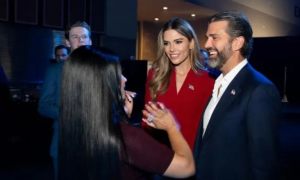
Kimberly Guilfoyle has chosen a measured and composed public response following the announcement of Donald Trump Jr.’s engagement to socialite Bettina Anderson, a development that quickly drew widespread media attention. In a New York Times interview published on January 4, Guilfoyle addressed the news directly for the first time, offering a brief statement that emphasized goodwill rather than personal reflection. She said she was happy for Trump Jr. and wished him the best, keeping her comments neutral and restrained. The tone of her response stood out in a media environment often driven by speculation and emotional reactions, particularly given the high-profile nature of her past relationship with Trump Jr. Observers noted that her words appeared carefully chosen, suggesting an effort to maintain dignity and avoid fueling unnecessary controversy. By limiting her remarks to a few courteous sentences, Guilfoyle signaled a desire to move forward publicly without revisiting the details of a relationship that once attracted intense scrutiny.
The engagement itself was revealed in December 2025 by President Donald Trump, bringing an official confirmation to what had already been the subject of public curiosity. The timing of the announcement placed it roughly a year after Guilfoyle and Trump Jr. ended their relationship, which had spanned several years and included a highly visible engagement. The couple became engaged on New Year’s Day in 2022, a moment that was widely covered due to their prominence in political and social circles. Their separation in 2024 was described at the time as amicable, with reports emphasizing the absence of public conflict or dramatic fallout. Both parties largely avoided speaking in detail about the breakup, reinforcing the perception that the relationship ended quietly rather than explosively. This context has shaped how audiences interpret Guilfoyle’s recent comments, viewing them not as a sudden reaction but as part of a longer pattern of discretion and restraint.
Despite the outward calm reflected in Guilfoyle’s statement, media reports citing unnamed sources have suggested that the situation may be more emotionally complex behind the scenes. According to these accounts, Guilfoyle and Trump Jr. have remained on friendly terms since their separation, maintaining a level of mutual respect that has allowed them to coexist within overlapping social and political circles. At the same time, some insiders have claimed that Guilfoyle has privately wrestled with mixed feelings about the engagement, including doubts about whether the new relationship is the right long-term match for Trump Jr. These reports, while not confirmed by Guilfoyle herself, reflect the tendency of public narratives to search for deeper emotional undercurrents beneath polished public statements. They also underscore the challenge faced by public figures whose personal lives remain a subject of ongoing speculation long after a relationship has ended.
Guilfoyle’s continued connection to the Trump family has further complicated public interpretation of her response. Reports indicate that she remains viewed positively within the broader Trump circle, a dynamic that is unusual in the aftermath of a high-profile breakup. Rather than being sidelined or distanced, she has reportedly maintained cordial relationships, suggesting that her role within that world did not hinge solely on her engagement to Trump Jr. This ongoing connection may help explain the careful tone of her remarks, as public criticism or visible resentment could disrupt relationships that remain professionally or socially significant. It also highlights the blurred boundaries between personal and public life that often characterize relationships involving prominent political families, where individual choices are closely watched and widely discussed.
Meanwhile, Donald Trump Jr.’s relationship with Bettina Anderson has steadily moved into the public eye. The two were first linked after being spotted together in Florida, prompting speculation that was later confirmed by the engagement announcement. Subsequent reports have suggested that Trump Jr.’s family approves of the relationship, reinforcing the sense that it has been embraced rather than merely tolerated. This apparent approval has contributed to a narrative of forward momentum, positioning the engagement as a new chapter rather than a point of controversy. Within that context, Guilfoyle’s response can be seen as aligning with the broader tone set by those around Trump Jr.—one that emphasizes continuity, stability, and cordial relations over conflict or division.
Ultimately, Guilfoyle’s brief remarks appear to reflect a deliberate choice to separate public posture from private emotion. By offering polite well wishes without elaboration, she maintained control over her narrative while avoiding the pitfalls of oversharing or public confrontation. In an era where personal reactions are often amplified and dissected across social media and news platforms, her restraint stands out as a strategic and perhaps self-protective decision. Whether or not more complicated feelings exist privately, Guilfoyle’s public stance reinforces an image of professionalism and composure. Her response serves as a reminder that silence, brevity, and courtesy can be powerful tools for public figures navigating personal transitions under intense scrutiny, allowing them to acknowledge change without being defined by it.