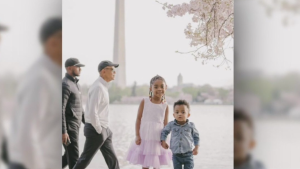
They had gone to the Tidal Basin for something simple, the kind of outing families plan without imagining it will ever matter beyond the day itself. A borrowed dress shirt for Dad that still held the faint scent of someone else’s laundry detergent, sleeves rolled because it was a touch too big. A toddler who refused to stand still, more interested in the gravel underfoot and the distant ducks than in any request to smile at a stranger holding a camera. Above them, the cherry blossoms stretched out in soft pink abundance, their petals drifting lazily in the breeze and settling briefly on shoulders before being carried away again. Strangers slowed their steps beneath the trees, pausing mid-conversation, instinctively quieter as if the blossoms demanded reverence. Portia felt it too—that gentle, collective breath people take when something beautiful interrupts the rush of ordinary life. She didn’t want perfection. She didn’t want a masterpiece. She just wanted proof: proof that they had been there together, that this ordinary, tender day had existed exactly as it felt in the moment. A photograph to anchor memory, something to look back on years later and say, Yes, we were happy there. Yes, that happened.
The photographer worked with practiced ease, guiding them into position as families all over the Basin had done for decades. A hand lightly on a shoulder, a quiet suggestion to tilt a chin toward the light, a soft joke meant to coax cooperation from a restless child. Portia adjusted her posture, aware of the camera but not self-conscious, the way you are when you trust that this moment doesn’t need to be anything more than what it is. The toddler squirmed, the blossoms fluttered, and the world continued on behind them—tourists strolling, joggers passing, locals weaving through the crowd with the familiarity of people who had seen this scene many times before. The photographer counted down, eyes focused through the lens, unaware that something extraordinary was approaching from just beyond the frame. History, unannounced and unguarded, was walking casually along the path, hands at ease, face relaxed. There were no sirens, no sudden hush, no signal that anything out of the ordinary was happening. The shutter clicked. A fraction of a second froze the alignment of people, petals, light—and a figure who had once stood at the center of global attention now drifting effortlessly into a family’s private moment.
It wasn’t until later that evening, long after the blossoms had faded into memory and the toddler had finally surrendered to sleep, that Portia discovered what the camera had captured. Curled on the couch, the quiet hum of the house settling around her, she scrolled through the images with the casual expectation of reviewing memories still warm. There were the smiles, the almost-smiles, the slight blur from a child’s sudden movement. Then she stopped. Her breath caught, not from disbelief exactly, but from the strange sensation of recognition colliding with context. There he was in the background, unmistakable and utterly ordinary at the same time. Casual. Unguarded. As if he’d wandered out of a documentary or a history book and into their lives without ceremony. For a moment, she wondered if she was mistaken, if her mind was playing tricks on her. But the longer she looked, the clearer it became. This wasn’t imagination. This was real. The photograph held a quiet collision of timelines: a family’s fleeting afternoon and a figure whose presence had once shaped headlines, policy, and history itself.
The internet, as it does, reacted swiftly and loudly. What had been a private discovery became a shared astonishment, then a public marvel. The image traveled far beyond the living room where Portia first noticed it, sparking laughter, surprise, and admiration from people who had never set foot in that moment. Headlines followed. Comments multiplied. The photograph was labeled charming, surreal, iconic. Yet amid the noise of virality, what stayed with Portia wasn’t the attention. It was the intimacy of the realization. History had not arrived with a speech or a spotlight. It hadn’t demanded acknowledgment. It had simply passed by, human and unremarkable in posture, sharing the same spring afternoon as everyone else. The power of the image wasn’t in fame intruding on a family photo; it was in the reminder that the people we elevate to symbols still move through the world like the rest of us, intersecting with ordinary lives in ways neither side can predict.
The photograph became something deeper than a novelty. It transformed into a meditation on proximity—how close we all are, at times, to moments that later seem impossible. The Tidal Basin had always been a place where personal and national memory overlapped. Presidents had spoken nearby. Protests had gathered there. Countless families had marked milestones under those same blossoms. Yet this moment distilled that shared space into a single frame. A toddler unaware of significance. Parents focused on holding a pose. A former president enjoying a walk beneath blooming trees. No hierarchy, no separation, just people coexisting within the same slice of time. It underscored how history isn’t always confined to textbooks or anniversaries. Sometimes it appears briefly, unannounced, and leaves again without explanation. You don’t recognize it as history when it happens. You recognize it later, when distance and reflection turn coincidence into meaning.
Years from now, the blossoms will bloom again, and countless other families will stand where Portia once stood, hoping to capture something they can carry forward. Most of their photos will remain what they were intended to be—records of love, presence, and passing time. But this one will endure as a quiet testament to the way life layers itself, ordinary moments brushing against the extraordinary without warning. For Portia, the image will always mean more than a viral story. It will be proof that a gentle day really happened, just as she wanted. Proof that memory can be anchored in unexpected ways. And proof that history doesn’t always announce itself with grandeur. Sometimes it simply walks by under the blossoms, sharing the same air, the same light, and the same fleeting spring afternoon before moving on.