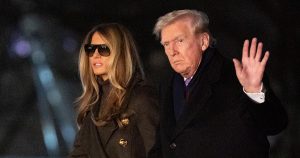
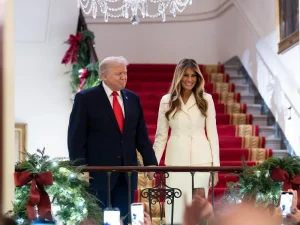
When Donald Trump and Melania Trump returned to Washington, D.C., following the Thanksgiving holiday in Florida, the arrival was expected to be a standard transition back to political routine. Late Sunday night, Marine One touched down on the White House lawn, its familiar whirring signaling the end of the holiday weekend. Cameras captured the couple stepping off the helicopter under bright security lights, an image that would normally pass quickly through the news cycle. Instead, within hours, photos and short video clips began circulating widely online. Attention shifted away from the return itself and focused intensely on a small but striking detail: Melania Trump was wearing sunglasses, despite the nighttime setting. What might have gone unnoticed for most travelers quickly became a focal point for commentary, speculation, and debate.
The Trumps had spent the Thanksgiving holiday at Mar-a-Lago in Palm Beach, Florida, a location long associated with both family time and political gatherings. During the visit, Donald Trump made several public appearances, engaging with supporters and attending events that drew media coverage. Melania Trump, by contrast, kept a relatively low public profile throughout the holiday weekend. Reports suggested she focused on private family time, particularly with their son, Barron. That period of quiet visibility ended abruptly upon their return to Washington. As Melania stepped onto the South Lawn, dressed neatly and appearing calm, the sunglasses immediately stood out under the intense lighting used for nighttime security and press documentation. The contrast between the dark sky and the reflective lenses made the accessory impossible to ignore.
Online reactions emerged almost instantly and varied widely in tone. Some social media users treated the moment with humor, joking about nighttime sunglasses and referencing pop culture clichés involving celebrities avoiding attention. Others took a more analytical approach, suggesting practical reasons for the choice. Bright floodlights, camera flashes, eye sensitivity after flying, or even a desire for a brief layer of privacy were among the explanations offered. Several commentators pointed out that sunglasses are commonly worn by public figures during arrivals and departures, regardless of time, as a way to manage glare or avoid intense scrutiny. Still, the sheer volume of discussion demonstrated how even minor fashion choices can become amplified when attached to a well-known figure.
The discussion also reflected a broader pattern in how Melania Trump has been perceived throughout her time in the public eye. Her fashion choices have consistently drawn attention, often interpreted as statements whether intentional or not. Known for a reserved, formal, and minimalist style, she has frequently been praised for elegance while simultaneously facing criticism or overanalysis. The sunglasses fit neatly into this pattern. For some observers, they symbolized detachment or mystery; for others, they represented nothing more than personal comfort. The lack of explanation allowed interpretations to multiply, illustrating how silence can sometimes fuel speculation more than any statement would.
More broadly, the moment highlighted how the modern media environment operates, particularly in the age of social media. Images captured during routine events can quickly escape their original context and take on new meanings once shared, edited, and commented on by millions of users. A single still frame can generate narratives far beyond what actually occurred. In this case, a late-night arrival after holiday travel became a talking point not because of policy or politics, but because of an accessory. The episode underscored how public figures, especially those connected to political power, are rarely afforded the anonymity or casual flexibility that private individuals enjoy.
Ultimately, the attention surrounding Melania Trump’s sunglasses says less about the accessory itself and more about the public fascination with symbolic details. Whether the choice was made for comfort, privacy, or simple habit, it became a reminder that high-profile individuals are often viewed through a magnifying lens. Everyday actions can be transformed into viral moments, stripped of context and layered with meaning by observers. In an era where images travel faster than explanations, even the most routine arrival can spark widespread discussion. The episode serves as a clear example of how modern public life blurs the line between the ordinary and the extraordinary, turning fleeting moments into lasting conversations.