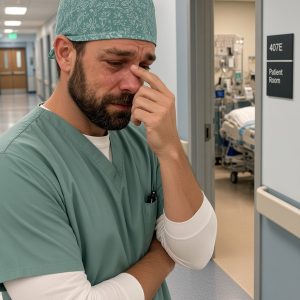
For forty-seven endless days, my twelve-year-old son lay silent in a hospital bed, his small body connected to machines that breathed, monitored, and waited on his behalf. The accident had happened in seconds—a basketball bouncing into the street, a child following it without thinking, a motorcycle appearing too fast to outrun. The sound of tires and sirens still echoed in my head as I sat beside him, counting heartbeats and praying for movement. Doctors spoke carefully, offering facts and probabilities, while I measured time in blinks and shallow breaths.
The police explained it gently. The rider hadn’t been reckless. He hadn’t been drunk. He hadn’t fled. He had stopped, called for help, and performed CPR until the ambulance arrived. On paper, it was simply an accident. But reason has no place in a parent’s fear. All I saw was the man whose bike had collided with my son, the face I imagined whenever I closed my eyes.
I met him on the third day. I walked into Jake’s room and found a stranger sitting beside the bed, holding a book and reading aloud. He wore a leather vest, his beard streaked with gray, his voice low and steady. Something inside me snapped. I shouted, demanded he leave, nearly struck him before security intervened. My anger needed a target, and he was standing right there.
He came back the next day anyway. And the day after that. Each morning he sat in the same chair, reading or talking as though Jake were awake. My wife, Sarah, watched him differently. She reminded me he hadn’t run, that he had tried to save our son. She said maybe he needed to be there as much as Jake needed to hear a voice. I didn’t understand her then.
The man’s name was Marcus. He brought books Jake loved—fantasy stories full of courage and magic. He spoke about baseball scores, the weather, motorcycles. One afternoon, he told Jake about his own son, Danny, who had died twenty years earlier in a car accident. Marcus hadn’t been there when it happened. The regret still lived in his eyes. Sitting beside my unconscious child, he said, was his way of making amends with the past.
That was the moment my hatred began to loosen. I started staying in the room when Marcus visited. We didn’t talk much at first. We just watched Jake together, two fathers bound by loss and hope. Sometimes I heard Marcus whisper encouragement, urging my son not to give up, promising there was still a world waiting for him.
By the third week, the hospital room felt less empty when Marcus was there. One day, he arrived with fifteen members of his motorcycle club. They couldn’t fit inside, so they lined the street outside and revved their engines together, the sound vibrating through the building. Sarah cried, saying Jake loved motorcycles and might hear them. That night, the nurse told us his heart rate had jumped briefly, a small sign that felt like a miracle.
As days passed, doctors began using words I dreaded—permanent damage, long-term care, uncertainty. On the thirtieth day, I broke down in the hallway, overwhelmed by fear. Marcus sat beside me without speaking, his presence solid and steady. When he finally spoke, he told me not to give up. Somehow, his belief carried me when my own strength failed.
Two days before everything changed, Marcus brought a small box containing a model motorcycle kit. He said we would build it together when Jake woke up. I couldn’t answer him. Hope hurt too much.
On the forty-seventh morning, Marcus was already there, reading softly. I noticed a slight movement in Jake’s hand, barely more than a twitch. We froze. Then it happened again. Machines began to beep faster. Jake’s eyelids fluttered open, confusion giving way to awareness. Nurses rushed in as I grabbed his hand, calling his name.
Jake’s eyes settled on Marcus. In a rough whisper, he said he remembered being saved—being pulled back, held, and reassured. Marcus tried to apologize, but Jake shook his head, insisting he remembered kindness, not harm. Marcus wept openly, the weight of decades lifting in that moment.
Recovery took time, but Jake’s mind remained clear. He remembered hearing Marcus read to him, remembered the stories about Danny. He said he didn’t want Marcus to be sad anymore. From that day on, Marcus visited daily until Jake went home. On discharge day, he gave Jake a small leather vest labeled HONORARY NOMAD, welcoming him into his chosen family.
Two years later, Jake is healthy and joyful, back on the baseball field. Marcus joins us for Sunday dinners. They rebuilt that model motorcycle and now work on a real one in my garage, laughing with grease-stained hands. Forgiveness, Marcus once told me, isn’t earned—it’s lived. Watching them together, I finally understood. An accident took us to the edge of despair, but compassion carried us back, transforming pain into purpose and strangers into family.