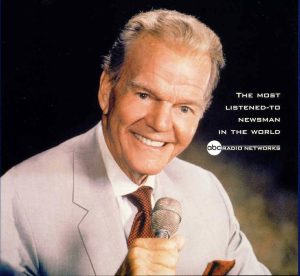
Paul Harvey’s 1965 broadcast, “If I Were the Devil,” has been shared and reshared for decades, often as a nostalgic piece of radio history. But in today’s context, its words feel unsettlingly accurate, almost prophetic. What once sounded like dramatic commentary now resonates as a mirror reflecting modern society. Hearing it in 1965, listeners could dismiss it as clever wordplay or a moralistic thought experiment. Listening today, however, it reads like a diagnosis — a startlingly precise description of the erosion of faith, ethics, and communal values over time. The broadcast, with its measured cadence and intentional gravitas, draws the listener into imagining the methods by which societal decay could quietly take hold. Harvey did not predict the future with numbers or dates; he illustrated human vulnerability and the slow, almost imperceptible ways that cultural values can be undermined, and in that, his message has endured.
In the broadcast, Harvey placed himself in the role of the Devil, not as a figure of fire and brimstone, but as a subtle strategist of corruption. He described a world where the destruction of a nation would not come through direct attack or overt violence, but through erosion from within. Quiet whispers would replace bold proclamations. Morality would shift slowly, almost imperceptibly, until behaviors once considered unthinkable became commonplace. Faith, once the cornerstone of public and private life, would be questioned, marginalized, and removed from institutions that had historically upheld it. Families would be distracted, weakened, and divided. Pleasure would replace principle, opinion would masquerade as truth, and freedom would be redefined to suit convenience rather than conscience. In essence, Harvey imagined a society in which virtue is undermined not by force but by temptation and distraction — a strategy that is as insidious as it is effective.
Harvey’s original words resonate powerfully:
“If I were the Devil, I would whisper: ‘Do as you please.’
I’d tell the young that the Bible is a myth.
I’d convince them that man created God, instead of the other way around.
I’d take God out of the courthouse, the schoolhouse—
and even out of the churches.
I’d peddle drugs and alcohol freely, distract families,
divide them, weaken their resolve.
I’d teach people to pray, not to God—but to government.
I’d replace wisdom with pleasure, truth with opinion,
and call it freedom.
And I’d keep doing it…
until the world slipped quietly into my hands.”
At the time, in 1965, Harvey’s listeners lived in a world vastly different from today. There were no social media platforms dominating attention, no smartphones providing constant distraction, and no global internet linking the spread of ideas at lightning speed. Yet Harvey anticipated, in essence, the vulnerabilities that would emerge decades later. He imagined a society where the foundations of character and community were slowly eroded, not through coercion, but through consent, distraction, and the reshaping of moral expectations. His voice carried a warning, couched in narrative drama, but beneath the cadence and radio theatrics was a deep understanding of human nature and the mechanisms of cultural change. The world he described, once hypothetical, now feels like a reflection of contemporary society.
Listeners in 1965 might have laughed at the drama or admired Harvey’s rhetorical skill. Listeners today, however, often experience a jolt of recognition. His words are shared not as nostalgia, but because they feel uncannily true. People recognize in his broadcast a portrait of modern life — the weakening of family bonds, the shifting moral compass, the increasing reliance on government or external authority rather than individual conscience. Some interpret it politically, others spiritually, yet nearly everyone sees in it a prescient awareness of trends that became visible only decades later. Harvey’s speech has outlived the radio era, spreading across forums, social media, and podcasts, its relevance undiminished by time. In this sense, it is less a speech and more a lens through which to examine the modern condition.
At the heart of Harvey’s broadcast is a call to responsibility. He famously stated, “Self-government won’t work without self-discipline.” These words, though brief, capture the essence of the problem he outlined. Modern societies, even the most technologically advanced, remain dependent on the individual choices of their citizens. When people abdicate responsibility, surrender critical thinking, or prioritize comfort over conscience, the slow corrosion of societal virtue accelerates. Harvey’s message was never intended as fear-mongering; it was a challenge. It asked listeners to consider the ways in which they contribute to or resist cultural decay. It called on individuals to recognize the power of their actions, their engagement, and their moral choices in shaping the world around them.
Ultimately, the enduring power of “If I Were the Devil” lies in its timelessness. Harvey’s voice, recorded in an era before digital media, continues to resonate because he was not merely commenting on the present; he was observing the human condition. The broadcast endures not as an artifact of radio history, but as a reminder of vigilance, self-awareness, and moral courage. Today, as we navigate a complex world filled with distraction, divided loyalties, and competing narratives, his words remain a call to reflection rather than despair. If his speech stirs something within a listener, it is meant to be passed on — not to alarm, but to awaken consciousness. Some voices echo long after their time precisely because they were never limited to it. Paul Harvey’s message, delivered over half a century ago, continues to challenge us to live with awareness, integrity, and responsibility, making it as urgent and relevant now as it was in 1965.