Smallpox, once among the deadliest viral infections in human history, caused high fever, intense fatigue, and a painful rash that left survivors permanently scarred. By the early 20th century, the disease was responsible for killing approximately 30% of those it infected, making it a constant global threat. The variola virus spread easily and rapidly, often devastating entire communities and leaving a trail of physical and emotional trauma. Survivors who lived through the illness frequently emerged with deep marks on their faces and bodies—permanent reminders of the ordeal. In response to this ongoing public health crisis, scientists raced to find a solution that would safeguard future generations from the virus’s destructive reach.
The breakthrough came with the development of a groundbreaking vaccine using vaccinia, a live virus related to variola but incapable of causing smallpox. When introduced into the body, vaccinia stimulated a strong immune response, training the body to recognize and fight off smallpox if exposed in the future. This scientific achievement became one of the most important milestones in medical history. Thanks to mass vaccination campaigns across the globe, smallpox cases steadily dwindled throughout the mid-20th century. In the United States, routine smallpox vaccinations ended in 1972, and by the early 1950s, most large outbreaks had been suppressed or eliminated. Ultimately, the World Health Organization declared smallpox eradicated worldwide by 1980, marking the first—and so far only—time humanity has successfully wiped out a human disease through coordinated global action. Today, only a small number of scientists or laboratory workers who handle related viruses receive the vaccine.
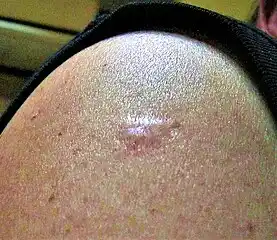
One of the most recognizable remnants of the vaccination era is the smallpox vaccine scar. Typically found on the upper left arm, this scar appears as a small, round, or slightly oval indentation, often no larger than the diameter of a pencil eraser. The appearance of the scar varies from person to person; some develop a smooth, shallow mark, while others have a raised or more pronounced scar due to a heightened immune response or variations in healing. Unlike modern vaccines, which are delivered through a single smooth injection using a thin needle, the smallpox vaccine involved a more intrusive technique. Medical providers used a bifurcated needle—essentially a forked tool with two prongs—dipped into the vaccinia solution before rapidly puncturing the skin multiple times in a small area. This repeated pricking created a noticeable injury, which in turn produced the distinctive scab and eventual scar that millions of people carry to this day.
The nature of the vaccine and its delivery meant that the body responded vigorously at the injection site. Within days, recipients would see redness, swelling, and a blister-like lesion form, often becoming sore or itchy. As the immune system worked to fight the live virus, the blister eventually formed a thick scab. After a few weeks, the scab would fall off naturally, leaving behind a permanent mark shaped by the body’s natural healing processes. While most vaccinations were administered on the upper left arm for consistency and easy visibility, some people—especially in earlier decades—received the injection in alternate locations, including the thigh or buttocks. These scars, though less commonly seen, still carry the same distinctive appearance. Although the vaccine was incredibly effective, some individuals experienced side effects, ranging from mild fever and swollen lymph nodes to more serious complications for those with eczema, weakened immune systems, or certain skin conditions. Severe reactions were rare but documented, underscoring the strength of the immune response triggered by the vaccine.
Today, smallpox vaccine scars have become something of a historical marker—a physical reminder of a disease that no longer circulates in the general population. Most people under the age of 50 have never received the vaccine, and medical professionals no longer administer it to the public. As a result, the appearance of the distinctive upper-arm scar often prompts curiosity, especially among younger generations unfamiliar with its origins. For individuals who wish to reduce the appearance of their scar for cosmetic reasons, several options are available. Dermatologists often recommend simple approaches such as using sunscreen to prevent discoloration or applying moisturizing ointments to soften the texture. More advanced treatments—including dermabrasion, laser therapy, and microneedling—may also help diminish the scar’s visibility, though the mark rarely disappears completely. In many cultures, however, the scar is seen not as an imperfection but as a badge of protection, a symbol of surviving an era before modern medicine conquered the disease.
The story of the smallpox vaccine—and the tiny scars it left behind—represents one of humanity’s greatest triumphs over disease. What was once a source of widespread fear, suffering, and death has been replaced by hope, scientific progress, and global cooperation. Although smallpox is no longer a threat to public health, the scars remain a powerful reminder of both the fragility and resilience of the human body. They symbolize a moment when medicine changed the course of history, protecting millions of lives and proving that coordinated vaccination efforts can defeat even the most formidable illnesses. As future generations grow up without ever witnessing the ravages of smallpox, these scars serve as silent storytellers—evidence of the battles fought before them and a testament to the life-saving power of vaccines.