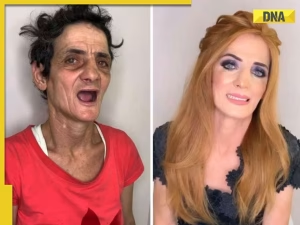
Rita’s story begins with profound loss, vulnerability, and years of hardship that slowly stripped her of nearly everything except the will to survive. After losing her only son, the grief became both a personal catastrophe and the beginning of her gradual separation from the world around her. Without family or resources, she slipped through every crack in the social system and ultimately found herself living on the streets. Day after day, she survived by collecting bottles, scraps, or anything that could be exchanged for enough money to keep her going. Unlike many who experience homelessness for a short period, Rita remained outside for years, invisible to most and judged by the rest. Her appearance—shaped by harsh weather, lack of nutrition, and the impossibility of self-care on the streets—became a barrier stronger than any locked door. Employers overlooked her before she could even speak. Passersby avoided her. And in time, the world taught her to expect rejection before she even approached anyone. Loneliness became the background of her life, interrupted only by the daily fight to stay alive.
But everything changed the moment she encountered Shafag Novruz, a makeup artist and stylist known for helping women who live on society’s margins. Shafag’s work focuses not on glamour but on restoration—offering beauty services to women who have been abandoned, abused, or forgotten. When she saw Rita, she didn’t see a homeless woman whose future was set in stone. She saw someone who had endured years of pain yet still held onto the smallest spark of resilience. Instead of turning away, she leaned in. Instead of seeing hopelessness, she saw potential. Shafag recognized that beneath the exhaustion, grief, and neglect was a woman who had once been loved, who had once belonged somewhere, and who deserved another chance to feel human again. Her philosophy is simple: sometimes restoring dignity starts with restoring the small things people stop believing they are worthy of.
The first step in Rita’s transformation was not makeup or hair—it was a visit to the dentist, fully paid for by Shafag herself. She understood that a smile is more than a cosmetic feature; it is a symbol of how people look at you and how you see yourself. Years of homelessness had left Rita with dental issues that caused pain, embarrassment, and further isolation. A broken or missing smile often leads to shame, making individuals avoid social interaction, job interviews, and even asking for help. By addressing this first, Shafag was sending a message: Rita deserved a foundation for rebuilding her life. The dental care restored not only physical appearance but emotional confidence. For Rita, who had gone so long without being treated as someone worthy of investment, this step alone was transformative. It marked the moment she realized someone believed she mattered.
Once her smile was restored, Shafag moved on to the outward transformation—the kind people can see immediately, but which often has deep emotional impact. Rita received a manicure and pedicure, small acts that symbolized care and attention she had not experienced in years. Then came fresh hair color in warm, uplifting tones, chosen intentionally to brighten her appearance and soften the hardened edges life had given her. Hair extensions added length and fullness, replacing the tired and brittle strands that had endured years without proper care. These changes were not done to erase who Rita was but to bring forward the version of herself that had been buried by grief and survival. In each step, Shafag treated Rita not as a charity case but as a woman deserving of respect, patience, and artistry. Every brushstroke and detail became a gesture of human acknowledgment.
The moment of revelation came when Rita was finally shown her reflection. After years of seeing only a worn, survival-hardened version of herself, the woman in the mirror felt like a stranger—yet one she wanted to know. She broke down in tears, the kind that come from release rather than despair, and then began to laugh, the way someone laughs when they suddenly feel something shift inside them. It was not merely a makeover; it was the return of identity. For the first time in years, Rita saw someone who looked like they belonged in the world, someone who might be welcomed rather than pushed aside. The emotional weight of that realization brought forward a flood of relief, gratitude, and the fragile hope that maybe her story wasn’t finished after all. Her reaction was a reminder of how deeply appearance intersects with dignity, and how transformative genuine care can be.
The before-and-after photos captured not a miracle, but a restoration of humanity. They showed the same person on both sides—same eyes, same history, same soul—but the second image reflected the strength and dignity that had been hidden by years of struggle. It proved that homelessness hadn’t robbed Rita of her identity; it had only obscured it. What the world interpreted as failure or decay was, in truth, the result of circumstances that no one could withstand without bearing scars. Shafag’s work reminded people that transformation is not about vanity—it is about helping someone reconnect with the parts of themselves they thought were gone forever. A few hours of skilled work and a profound act of kindness gave Rita something priceless: the belief that she could still have a future. That single shift—from being written off to being seen—became the catalyst for rebuilding her life. And for anyone witnessing her story, it was a reminder that dignity can be restored, that compassion can rewrite trajectories, and that no one is beyond the reach of hope when someone chooses to extend it.