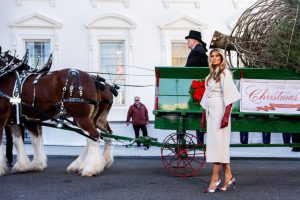
The 2025 arrival of the White House Christmas tree, a tradition stretching across generations, became far more than a seasonal ritual when Melania Trump stepped out to receive the towering Michigan fir. Although the ceremony typically follows a predictable script—horses, a carriage, the slow delivery of the evergreen destined for the Blue Room—this year’s moment evolved into a broader cultural spectacle. The setting itself, with its nostalgic tone, offered the expected blend of holiday elegance and political symbolism; yet Melania’s presence shifted the focus instantly from the tree to the First Lady herself. Her appearance dominated coverage across news networks, fashion forums, and online commentary within minutes, showcasing how even the most familiar White House traditions can be reframed by the presence of a uniquely scrutinized public figure.
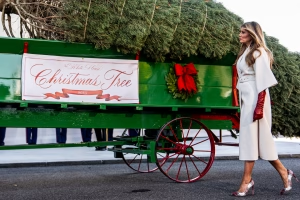
The event unfolded with deliberate cinematic charm. Two Clydesdales named Logan and Ben pulled the carriage at a dignified pace while a military band played nearby, their brass instruments gleaming in the late-autumn light. Three men in vintage attire accompanied the delivery, evoking imagery from earlier chapters of American holiday celebrations. Against this carefully staged tableau, Melania emerged as the visual centerpiece—standing atop the North Portico steps, composed and quiet, acknowledging the handlers and admiring the tree with a reserved smile. Her outfit, a winter-white belted Dior coat paired with vivid red gloves and tartan Manolo Blahnik heels, immediately became the subject of intense analysis. The stark contrast between the pure white fabric and the bright accessories made her appear both festive and commanding, ensuring that her fashion choices defined the first impression of the entire event.
Reactions online followed the well-worn path familiar to anyone who has watched public discourse around Melania Trump. Humor circulated quickly, with users comparing her coat to a luxurious bathrobe or an extravagant winter dressing gown. Others praised her style as elegant and timeless, emphasizing her consistency in presenting a polished, composed image regardless of political tensions. The intensity and speed of the reactions reflected how deeply she remains embedded in the cultural imagination: admired by some as a fashion icon, criticized by others as an aloof public figure, and consistently interpreted through the lens of broader political feelings. Her appearance once again became a cultural mirror, revealing the divisions, expectations, and emotional undercurrents that shape public perception of figures associated with the presidency.
Compounding the attention was her newly lightened hair, described by stylists as “cinnamon blonde,” a blend of warm honey and tawny tones that softened her overall appearance. This shift in color added a fresh visual appeal that many commentators noted complemented the crisp whiteness of her coat. Seemingly small details—her gloves, her shoes, the way the coat folded at the waist—became part of a larger conversation about her evolving public persona. In the age of social media, where images circulate instantly and public figures are analyzed frame by frame, Melania’s style became more than an outfit; it became a thematic element in the story of the ceremony, shaping how people interpreted her mood, her intentions, and her ongoing role as First Lady.
But the scrutiny did not remain focused solely on fashion. The resurfacing of the 2020 leaked recordings—in which Melania expressed frustration with holiday responsibilities and political pressures—reentered the conversation, revealing how past controversies continue to shape present-day interpretations. Critics revived earlier arguments questioning her sincerity in embracing holiday traditions, while supporters countered by highlighting the extreme pressures and constant criticism she faced during her husband’s first term. This layered backdrop of admiration, suspicion, and memory infused the event with meaning beyond the Christmas tree itself. Even a seemingly simple ceremonial moment thus became a reflection of deeper tensions and unresolved narratives surrounding her time in public life.
In the end, the ceremony fulfilled its traditional purpose: marking the beginning of the White House holiday season and symbolizing continuity in a nation defined by change, debate, and diversity. Yet the multilayered reception of the moment illustrated how the simplest rituals can evolve into complex cultural touchpoints. Melania Trump—reserved, visually striking, and enigmatic—remains a figure whose presence compels interpretation, even when she says very little. As the evergreen tree awaited its decorations inside the mansion, the outside world turned her appearance into a mosaic of admiration, criticism, nostalgia, and fascination. The ceremony, elevated by modern scrutiny, stood as a reminder that in today’s political and cultural landscape, even the arrival of a Christmas tree can become a national story shaped as much by its symbolism as by the woman standing beside it.