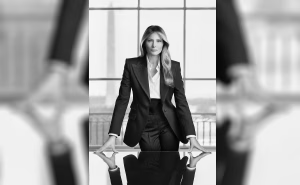
Melania Trump’s newly unveiled official White House portrait, released on January 28, 2025, has quickly become a subject of intense public and media scrutiny, sparking widespread discussion about its aesthetic, symbolic, and cultural significance. Captured in black and white by Belgian photographer Régine Mahaux, the image presents the former First Lady in a sharply tailored black suit with high-waisted trousers, a striking departure from the softer, glamorous imagery of her 2017 portrait. The directness of her gaze and the composure of her posture convey a deliberate message of authority, restraint, and self-possession, suggesting that Melania is consciously projecting a redefined identity that prioritizes power and control over ornamental elegance. In many ways, the portrait communicates that her influence and presence extend beyond the performative expectations of a former First Lady, offering a visual statement about autonomy, deliberate representation, and the lasting imprint of her public persona.
The photograph’s monochrome palette contributes to a timeless, formal aesthetic that draws attention to composition, light, and texture rather than the distractions of color. By emphasizing contrast, shadow, and structural elements, the portrait highlights Melania’s precision and poise, framing her as both disciplined and sophisticated. The Washington Monument rises clearly in the background, anchoring the portrait in national symbolism and reinforcing her enduring connection to American political life. Its presence subtly communicates continuity and stability, positioning Melania within a historical continuum of public service and national identity. The interplay between her poised figure and the monument behind her creates a layered narrative in which fashion, posture, and geography converge to produce an image that is as symbolic as it is visually striking, blending personal authority with national significance.
Public reaction to the portrait has been sharply divided, reflecting the complexity of Melania’s public image and the broader fascination with her persona. Admirers have lauded the work for its elegance, composure, and classic aesthetic, praising the timeless quality imparted by the black-and-white format and the precision of her tailored attire. For these viewers, the portrait aligns her with iconic figures in political and fashion history, reinforcing her status as a cultural symbol of poise and sophistication. Critics, by contrast, interpret her expression as distant or severe, suggesting that the image reinforces perceptions of aloofness or emotional detachment. This polarized response demonstrates the persistent public interest in Melania’s carefully curated identity, which has long oscillated between glamour, mystery, and quiet defiance, and it highlights how a single image can become a site for debates over personality, perception, and societal expectation.
The release of the portrait follows Melania’s widely discussed appearance at a recent presidential inauguration, where she wore a dramatic, wide-brimmed black hat that immediately sparked commentary across media platforms. Much like the portrait, the hat prompted mixed interpretations, with some observers reading it as somber or even funereal, and others seeing it as an assertive statement of personal power. Together, these appearances indicate a deliberate strategy to recalibrate her public persona through visual and sartorial cues. By leveraging fashion, posture, and visual framing, Melania continues to navigate the delicate balance between political distance and cultural visibility, ensuring that her image is simultaneously commanding, enigmatic, and carefully controlled. Her visual messaging operates as a subtle form of communication, signaling authority and self-definition without the need for explicit words.
Throughout her public life, Melania has consistently used style and image as primary tools for influence, often prioritizing discretion over verbal expression. The new portrait extends this strategy, demonstrating how control over visual representation can assert identity, convey stability, and create lasting cultural resonance. Every element—from the monochrome photography and precise tailoring to the monument in the background—works cohesively to project a message of self-possession and permanence. The portrait encourages interpretation without demanding approval, allowing Melania to remain the author of her own narrative while inviting public engagement. By presenting herself in this way, she not only maintains her legacy within the visual and political culture of the United States but also offers an example of how fashion and imagery can function as deliberate instruments of identity formation and social authority.
Beyond aesthetics and fashion, the portrait prompts broader reflection on legacy, perception, and the interplay between image and meaning in public life. The public discourse surrounding it—ranging from admiration to critique—reveals how visual representation can simultaneously reveal and conceal, shaping collective understanding while leaving room for individual projection. Drawing on the notion that images operate on both conscious and subconscious levels, the portrait encapsulates a complex dialogue between personal agency and public interpretation. While immediate reactions have been mixed, the photograph’s enduring significance will likely emerge over time, as viewers consider not only Melania’s poise and style but also the larger implications of a public figure asserting authority through carefully constructed visual language. In capturing this moment, the portrait invites contemplation of how image-making intersects with identity, power, and legacy, illustrating that the lasting influence of public figures is as much visual and symbolic as it is verbal or political.
Ultimately, Melania Trump’s 2025 White House portrait serves as both a statement of personal identity and a reflection on the cultural weight of visual representation. It emphasizes discipline, control, and the silent power of style while situating her within a broader narrative of national symbolism. By choosing black-and-white photography, precise tailoring, and a backdrop anchored in political history, Melania conveys authority, permanence, and the careful cultivation of legacy. The portrait demonstrates that influence can be exerted quietly, through visual cues rather than overt declarations, and that the interplay between fashion, posture, and composition can communicate as much as any speech or public statement. Over time, the image is likely to be remembered not simply for the immediate reactions it provoked, but for what it symbolizes: a woman shaping her public identity with intention, sophistication, and enduring authority, creating a legacy that continues to resonate long after the lens has captured the moment.