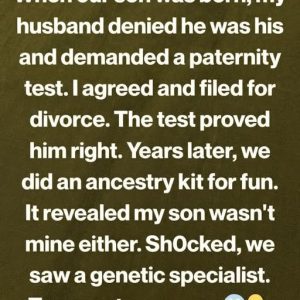
I contacted my former husband, believing he might finally want to understand what had happened. I explained the specialist’s findings and how this rare condition could cause DNA results from different tissues to appear contradictory. For the first time, I could offer an explanation for why the original paternity test had seemed to prove I was unfaithful when I knew I had never betrayed him. I imagined he might feel regret, perhaps even ask about the son he had left behind. Instead, he accused me of inventing an elaborate story because I wanted him to help pay for our son’s college education. His suspicion had survived even the truth he once claimed to need. His response hurt, but it no longer destroyed me. I had spent years wishing he would believe me. Now I understood that I couldn’t force someone to accept an explanation when he was determined to reject it. My son had grown into a thoughtful, confident teenager, surrounded by people who loved him without demanding proof of his worth. Whatever his biological history revealed, he was still the child I had carried, delivered, comforted, and raised.
For years, I had believed the end of my marriage was the greatest tragedy of my life. The discovery of chimerism showed me how incomplete that chapter had been, but it could not return the years we had lost or undo the pain of being accused and abandoned. I had hoped the truth would bring reconciliation, yet I no longer needed my former husband’s approval to move forward. My son and I had built a peaceful life without him, and that life was real regardless of what any test reported. I had lost a marriage to suspicion, but I had gained something precious: the freedom to raise my child in a home where love did not depend on accusations, appearances, or laboratory results. Sometimes, answers arrive too late to repair the past. They can still help us understand it—and finally let it go.



This Post Has One Comment