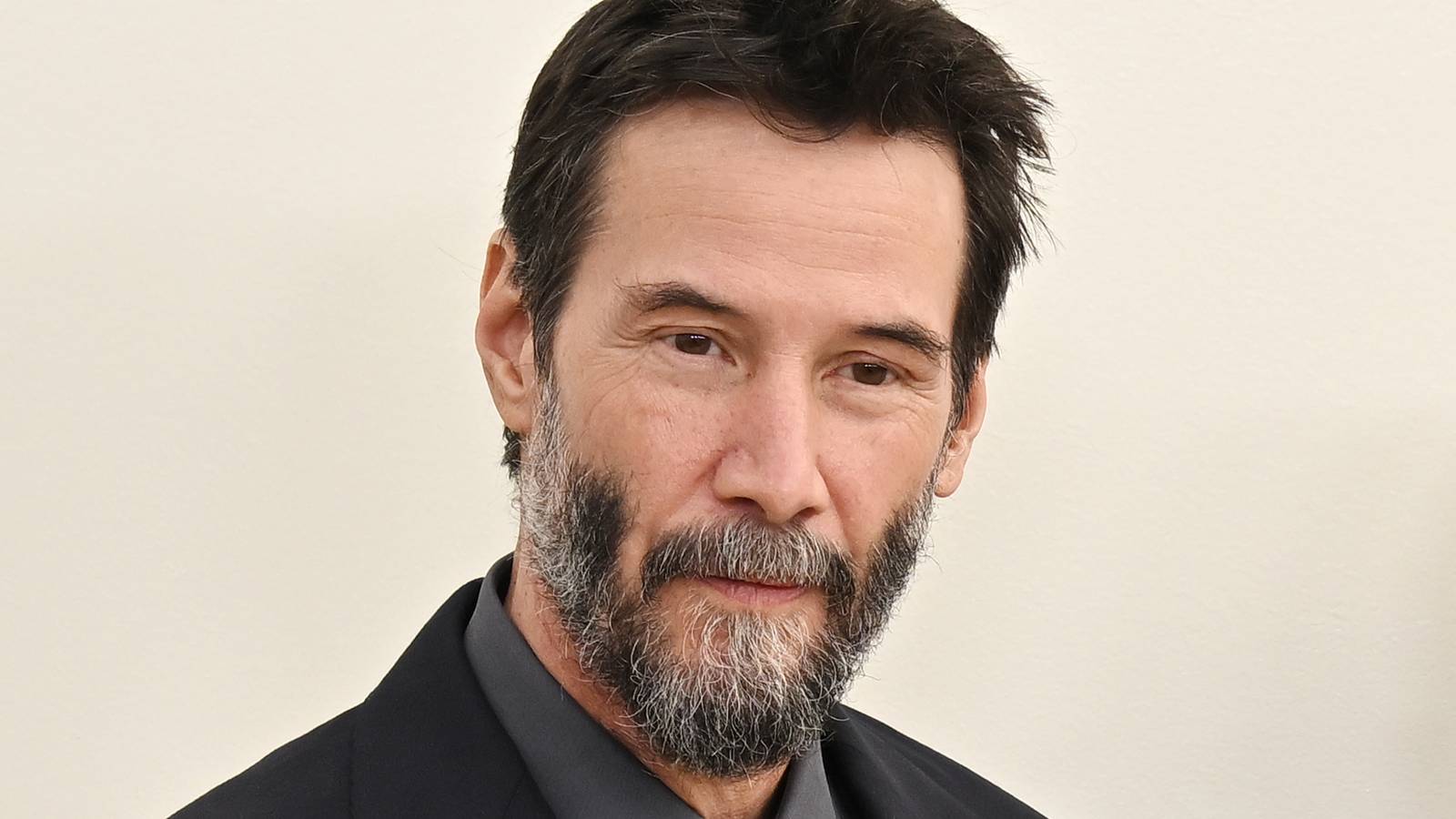
1. A Life That Never Followed a Straight Line
The life of Keanu Reeves is often described in public imagination as a smooth ascent from relative obscurity into global fame, as though his success unfolded according to a clean, cinematic blueprint. But that perception collapses the moment his story is examined with any seriousness. What appears to be simplicity on the surface is actually a life shaped by displacement, instability, and constant adaptation. There was never a single defining moment that launched him forward. Instead, there was a long sequence of uneven experiences that slowly shaped the person he would become.
Reeves spent his early years moving between countries and households, a result of his parents’ separation and the shifting circumstances that followed. He lived in environments that changed frequently, adapting to new schools, new cultures, and new social expectations. This kind of childhood does not create stability; it creates awareness. He learned early that nothing stays fixed for long, and that understanding people and environments quickly was often more valuable than expecting permanence.
This constant movement influenced more than just his upbringing—it shaped his internal rhythm. He became observant, reserved, and careful with expression. Instead of reacting loudly to change, he absorbed it. Those traits would later become defining elements of his screen presence. When audiences describe his acting as grounded or quietly intense, they are often responding to a lifetime of adaptation that preceded any film role.
Unlike many actors whose biographies feature early stability or clearly defined artistic training paths, Reeves’ journey was fragmented. He did not grow up within a single cultural framework or consistent educational trajectory. Instead, he assembled his identity across different environments, learning to exist in transition rather than in certainty. That background created a kind of emotional flexibility that would later serve him in roles requiring restraint, emotional subtlety, and internal complexity.
By the time he began pursuing acting seriously, he was already accustomed to uncertainty. This did not make the path easier, but it made it familiar. What others experienced as rejection or instability, he had already learned to recognize as part of normal life. That quiet familiarity with unpredictability would become one of the hidden foundations of his resilience.
2. The Early Career Years: Persistence Without Guarantee
Before Keanu Reeves became a globally recognized name, his career followed a path familiar to many aspiring actors but defined by far fewer guarantees. He entered an industry where competition was constant and recognition was rare. Casting decisions often favored more conventional profiles, and Reeves’ presence did not immediately fit into established categories. He was not rejected once or twice—he was repeatedly overlooked, a reality that quietly defines the early careers of many who eventually succeed.
There were moments when stepping away would have been the logical choice. Acting offered no immediate stability, and the outcomes of auditions were often disappointing. Yet Reeves did not approach his early career with dramatic defiance or visible frustration. Instead, he continued working. He auditioned again and again, took smaller roles when they appeared, and treated each opportunity as part of a long-term process rather than a single decisive moment.
This persistence was not rooted in ambition alone. It reflected something more internal: a commitment to the craft itself. Acting, for him, was not just a pursuit of recognition. It was a form of exploration. Each role, no matter how small, offered a chance to refine timing, emotional control, and presence. Over time, this approach built a foundation that was less about immediate success and more about accumulation.
He also navigated a period in Hollywood where identity and image played a significant role in casting decisions. His calm demeanor and understated personality were sometimes misinterpreted as lack of intensity or emotional range. In an industry that often rewards exaggeration, subtlety can be overlooked. Reeves, however, did not adjust his core personality to fit expectations. Instead, he allowed his work to speak gradually for itself.
What makes this period significant is not a single breakthrough, but the absence of one. His rise was incremental, built on repetition rather than revelation. Small roles led to slightly larger opportunities, which eventually created visibility. But even as his presence in film increased, there was no immediate transformation into stardom. It was a slow accumulation of trust between actor and audience.
This gradual development shaped the kind of performer he became. Instead of relying on theatrical intensity, he leaned into restraint. Instead of dominating scenes, he inhabited them. These choices were not stylistic experiments—they were natural extensions of how he had learned to exist in the world.
3. Recognition Without Simplification
When Keanu Reeves eventually gained widespread recognition, it did not erase the complexity of his career—it added another layer to it. Fame often simplifies public perception, compressing individuals into easily recognizable categories. Yet Reeves consistently resisted this flattening effect, even as his visibility increased dramatically.
Early major roles introduced him to global audiences, but they also led to misinterpretations. Some critics underestimated his range, labeling him as limited or overly restrained. Others mistook his quiet public persona for emotional distance or lack of depth. These interpretations, however, often failed to account for the intentionality behind his performance style.
Reeves’ acting is defined not by absence of emotion, but by containment of it. He often plays characters whose internal states are visible through subtle physical and emotional cues rather than overt expression. This approach requires precision rather than intensity. A shift in posture, a slight pause, or a change in eye focus can carry more weight than dialogue. For audiences attuned to this style, his performances feel deeply authentic.
Despite rising fame, he maintained a consistent independence in his career choices. Rather than exclusively pursuing commercially safe roles, he explored projects based on interest, collaboration, or creative curiosity. This occasionally resulted in uneven critical reception, but it also allowed him to avoid being confined to a single type of character or genre.
This independence is significant because it reflects a refusal to allow external expectations to dictate artistic direction. In industries where branding often becomes identity, Reeves maintained a separation between public perception and personal choice. He did not chase reinvention for its own sake, nor did he attempt to constantly reshape his image. Instead, he allowed his career to evolve organically.
Over time, this approach contributed to a body of work that feels diverse yet coherent. Whether in action films, dramas, or science fiction, there is a consistent emotional thread: restraint paired with presence. He does not overwhelm scenes; he anchors them.
Recognition, in his case, did not simplify him. It expanded the space in which his work could be interpreted.
4. Personal Loss and Quiet Endurance
Behind Keanu Reeves’ professional life lies a deeply human story shaped by loss, grief, and resilience. Unlike many public figures whose personal struggles become part of their public identity, Reeves has largely kept these experiences private. Yet they have undeniably influenced both his perspective and the emotional depth of his work.
Over the years, he experienced several tragedies that profoundly affected his life, including the loss of close relationships and family-related hardships. These events did not manifest in public displays of emotion or dramatic reinvention. Instead, they seemed to reinforce his already quiet and reflective nature.
What distinguishes his response to hardship is not avoidance, but restraint. He does not publicly frame his experiences as defining tragedies or transformative narratives. Instead, he carries them with a kind of internalized awareness that is reflected in his demeanor. This has contributed to the widespread perception of him as grounded and emotionally steady, even in environments that are often chaotic and performative.
Rather than becoming defined by loss, he appears to have integrated it into a broader understanding of impermanence. This perspective does not eliminate pain, but it changes how it is held. It allows for continued participation in life without requiring constant public acknowledgment of private experiences.
This quiet endurance has become part of how audiences interpret his on-screen presence. Many of his characters carry a similar emotional tone: individuals who have experienced loss but continue moving forward without dramatizing it. There is a sense of lived experience behind the performances that feels authentic rather than constructed.
In this way, his personal history and artistic expression often intersect without explicitly referencing each other. The emotional weight is present, but it is never forced.
5. Reinvention Without Reinvention
One of the most interesting aspects of Keanu Reeves’ career is how consistently he has remained relevant without relying on dramatic reinvention. In an industry where reinvention is often treated as essential for longevity, his approach is notably different. He does not radically reshape his public identity or chase constant rebranding. Instead, he adapts through continuity.
As his career progressed, he continued to take on roles that expanded his range rather than redefine him entirely. This allowed him to reintroduce himself to new generations of audiences while maintaining a consistent artistic identity. His work in later franchises demonstrated that he could engage with large-scale productions while still preserving emotional subtlety.
What makes this phase of his career particularly significant is that it does not represent a break from his earlier principles. Instead, it is an extension of them. He continues to prioritize meaningful engagement with roles, focusing on performance quality rather than image management. This consistency creates a sense of reliability that contrasts with the volatility often associated with fame.
In many ways, his career demonstrates that reinvention is not always necessary for longevity. Sometimes, sustained presence rooted in authenticity is enough. His ability to remain relevant without fundamentally altering his artistic identity suggests a different model of success—one based on endurance rather than transformation.
This approach has also contributed to his widespread respect within the industry. Directors and collaborators often describe him as committed, focused, and collaborative. He does not dominate productions with ego, but contributes with steady presence.
6. The Meaning of a Quiet Legacy
Keanu Reeves’ story ultimately challenges simplified narratives of success. It resists the idea that careers are built on singular breakthroughs or dramatic turning points. Instead, it reveals a more complex reality: that success is often the result of long-term persistence, emotional resilience, and a willingness to continue without certainty.
What makes his journey compelling is not only what he achieved, but how he achieved it. His path reflects accumulation rather than explosion, continuity rather than disruption. Each stage of his life builds upon the previous one, forming a layered narrative rather than a linear ascent.
His legacy is not defined solely by iconic roles or commercial success, but by the consistency of his presence. He has maintained a career that spans decades without losing the core qualities that defined him early on: restraint, authenticity, and emotional grounding.
In a cultural landscape that often prioritizes visibility over substance, his career stands as a reminder that impact does not always require loudness. Sometimes it is the quiet, steady presence that leaves the most lasting impression.
Ultimately, Keanu Reeves’ story is not just about fame or film. It is about how a person navigates uncertainty, loss, and change without losing their center. It is about persistence without spectacle, and success without distortion.
And perhaps that is why his work continues to resonate so deeply across generations.
Because beneath the roles, the fame, and the mythology, there remains something simple and enduring:
A person who kept showing up.