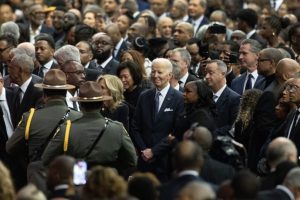
The farewell for Rev. Jesse Jackson Sr., the longtime civil rights leader and activist, drew some of the biggest names in American public life. Thousands gathered on March 6, 2026, at Chicago’s House of Hope Church for a public memorial honoring a man whose influence stretched across decades of struggle for racial equality, economic justice, and political participation. Among those in attendance were former Presidents Barack Obama and Joe Biden, as well as Bill Clinton, former Vice President Kamala Harris, and a wide range of civic leaders, faith figures, and longtime supporters. Speakers at the service reflected on Jackson’s impact, from his leadership in the civil rights movement to his two bids for the Democratic presidential nomination in 1984 and 1988, and his role as founder of the Rainbow PUSH Coalition. By nearly all accounts, the event was intended as a moment of tribute to a towering figure — a celebration of his moral courage, his commitment to community, and his lifelong fight for justice.
Yet the memorial quickly became part of a broader political conversation after several of the speakers used portions of their remarks to address the current state of the nation. In his eulogy, former President Obama spoke about what he described as pressures on American democratic norms and the challenges facing democratic institutions, suggesting that citizens were waking up to “assaults on democracy” and the erosion of shared values — comments widely interpreted as referencing the tenure of the sitting president, Donald Trump, even though he was not named. Similarly, Biden — recalling his own relationship with Jackson and his influence on his life — also addressed the political landscape, saying the country was in “a tough spot” and critiquing what he saw as a departure from principles the late civil rights leader championed. These remarks were praised by many attendees who felt they echoed the moral urgency Jackson embodied, but others saw them as politicized commentary at a service meant to honor a life of unifying work.
Not everyone welcomed the political overtones of the tributes. The strongest public criticism came from Jesse Jackson Jr., the late reverend’s son and a former congressman, who spoke the day after the public memorial at a more private ceremony held at the Rainbow PUSH Coalition headquarters in Chicago. Speaking to family, friends, and supporters, Jackson Jr. openly rebuked the former presidents, saying he had listened “for several hours to three United States presidents who do not know Jesse Jackson.” He argued that his father’s life and message were never meant to be confined within the boundaries of party politics — Democratic or Republican — but were instead rooted in a consistent moral commitment to “the least of these,” to people who were marginalized, dispossessed, and disrespected. By that measure, he suggested, the speeches they heard did not fully capture the breadth of his father’s vision.
Jackson Jr.’s criticism did not arise without context. In the hours and days after his father’s death was announced, he had already urged attendees and speakers to keep overt politics out of Jackson’s homegoing services, stressing that mourners of all political beliefs were welcome so long as they came with respect. His point was that Rev. Jackson’s life and legacy were broad and complex, touching people across the political spectrum, and that reducing his memory to a partisan moment risked distorting the fullness of his contributions. At the private service where Jackson Jr. spoke, he elaborated on that theme, emphasizing that his father’s advocacy was not intended to be a platform for contemporary political battles but a call to moral action that transcended partisan divides. His remarks made clear that, for him, the focus should have remained solely on honoring Jackson’s life rather than engaging in political critique.
So far, there has been no immediate public response from Obama or Biden directly addressing Jackson Jr.’s comments. The absence of a response has left the debate largely in media and public discourse, with coverage reflecting differing perspectives on the appropriateness of political references during moments of national remembrance. Meanwhile, another controversy had also unfolded around the time of Jackson’s death. On the day his passing was announced, former President Trump issued a tribute on the social platform Truth Social that praised Jackson while also making unverified claims about Jackson’s personal opinions of other political figures, specifically asserting that Jackson “could not stand” Obama. Multiple news outlets described that claim as unsupported or false, but it nonetheless illustrated how even Jackson’s death was quickly woven into the broader partisan narrative shaping American politics.
In the end, what has made the dispute so striking is how it underscores the depth of Jesse Jackson’s legacy and the enduring relevance of his work. Jackson spent decades forcing American society to confront issues of inequality, injustice, and political hypocrisy, and even in death he remains powerful enough to draw presidents, stir debate, and expose the tension between public tribute and political messaging. For some mourners, the speeches given at the public memorial reflected the very moral urgency Jackson fought for; for others, especially his son, they crossed a line and shifted attention away from the man they had come to honor. Either way, the reaction made one thing unmistakably clear: Jackson’s legacy is still not quiet, settled, or easily contained. It continues to be discussed, contested, and argued over because it still matters deeply to many Americans.