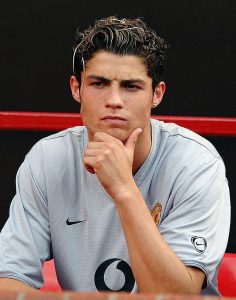
He grew up on a tiny, windswept island in the middle of the Atlantic Ocean. Long before the stadium lights, the record-breaking goals, and the billions of social media followers, there was just a skinny kid running through the narrow streets of Madeira, chasing a ball with relentless determination. That boy was Cristiano Ronaldo. Today, a rare childhood photo of him — shy smile, bright eyes, and a simple outfit — is going viral. Fans around the world are stunned by the contrast between the modest child in the image and the global icon he would later become. It’s hard to reconcile the polished superstar with the boy from a humble neighborhood in Funchal. Yet that contrast is exactly what makes his story so powerful. Before the fame and fortune, there was resilience. Before the records, there were obstacles. And before the world knew his name, he was just a child with a dream bigger than the island he called home.
Born in 1985 in Funchal, Madeira, Ronaldo was the fourth child in a working-class family with limited means. His father, José Dinis Aveiro, worked as a municipal gardener and part-time kit man, while his mother, Maria Dolores, struggled to keep the household afloat. Money was tight, and opportunities were scarce. In later interviews, his mother openly admitted that the pregnancy had been overwhelming. Already raising three children in difficult circumstances, she felt desperate. She has shared that she once attempted to induce a miscarriage after being advised by a neighbor that drinking strong dark beer and running intensely might end the pregnancy. It didn’t. He survived. That survival, improbable and fragile, became the first chapter in one of the most extraordinary careers in modern sport. It is a reminder that even the greatest stories sometimes begin in uncertainty, shaped by moments that could have turned out very differently.
Ronaldo’s childhood was far from glamorous. His father struggled with alcoholism, a reality the footballer has spoken about candidly over the years. He once admitted that he never truly had a normal, open relationship with his father because of the addiction. The home environment was complicated, marked by financial hardship and emotional strain. In 2005, his father died at the age of 52, before witnessing his son reach the absolute pinnacle of world football. Despite the instability, young Cristiano found focus and clarity on the pitch. Football became more than a game; it was an escape, a language, and a purpose. At just 12 years old, he left Madeira to join the academy of Sporting CP in Lisbon. The move was enormous for someone so young. He was homesick, teased for his accent, and struggled in school. He never progressed beyond sixth grade and was eventually expelled after an incident in which he threw a chair at a teacher he felt had disrespected him. Temperamental? Perhaps. But beneath the frustration was fierce ambition.
As if emotional and financial hardships were not enough, a medical scare nearly ended his journey before it truly began. As a teenager, Ronaldo was diagnosed with tachycardia, a heart condition that caused his heart to beat dangerously fast even at rest. For an aspiring athlete, the diagnosis was terrifying. Doctors performed a laser procedure to cauterize the affected heart pathways, correcting the irregular rhythm. The recovery was remarkably quick, and within days he was back to light training. For many young players, such a health crisis might have signaled the end of professional dreams. For Ronaldo, it became just another obstacle to overcome. The episode strengthened his discipline and sharpened his focus. He trained harder, pushed further, and refused to allow circumstances to dictate his future. The boy from Madeira had already survived uncertainty before birth, instability at home, and a heart condition that threatened his career. Each challenge seemed to add fuel to his determination.
His professional breakthrough came in 2003 when he signed with Manchester United. Under the guidance of experienced coaches and alongside elite teammates, his raw talent began to evolve into world-class performance. His speed, skill, and relentless work ethic quickly set him apart. Later, his record-breaking transfer to Real Madrid cemented his status as a global superstar. There, he shattered scoring records and collected major titles, transforming into one of the most recognizable athletes on the planet. On the international stage, he became the heartbeat of the Portugal national football team, earning over 220 caps and scoring more than 140 goals. He lifted the European Championship trophy and inspired a generation in his home country. Over the years, he has won multiple Ballon d’Or awards and, in 2024, became the first male player in history to score 900 official career goals. Off the field, his influence has been equally staggering, with record-breaking endorsement deals and over one billion total followers across social media platforms.
The childhood photo now circulating online contains none of that glory. There are no trophies, no designer suits, no flashing cameras. Just a thin boy with quiet eyes and untamed potential. Fans react with disbelief: “I can’t believe this was him,” some write. Others call him an inspiration, proof that background does not define destiny. What makes the image so powerful is not just the physical transformation, but the journey it represents. Behind the brand, the wealth, and the global fame, there was once a child navigating hardship in a modest home on an island many people could not find on a map. From a pregnancy that nearly ended before it began, to a heart surgery that threatened everything, to global dominance in football, Ronaldo’s story is not only about talent. It is about survival, resilience, and relentless self-belief. It is about a little boy from Madeira who refused to let circumstance decide his future — and instead decided it for himself.