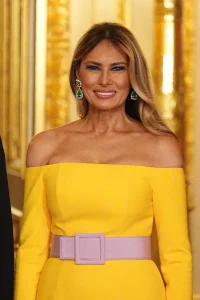
A recent poll has shed light on how the American public perceives former First Lady Melania Trump compared to other women who have held the role. While she is frequently seen in the public eye due to her marriage to former President Donald Trump, her personal presence and style have often generated debate. The poll effectively positions her alongside some of the most iconic First Ladies, such as Michelle Obama and Jacqueline Kennedy Onassis, highlighting both her popularity and the challenges she faced in capturing public admiration in the shadow of a politically polarizing husband. The survey results offer a glimpse into the nuanced ways Americans evaluate the contributions and personas of First Ladies beyond political alignment.
Melania Trump has always been a figure of intrigue, partly because of her carefully curated public persona and partly due to the controversies surrounding her husband’s presidency. While she often maintained a private lifestyle, her moments in the public spotlight, from White House appearances to media interviews, have invited scrutiny and comparison to previous First Ladies. The poll provides some insight into how much the public liked her performance in the role. Interestingly, the data suggest that while she was not universally admired, she was not the least popular First Lady either. In fact, the numbers indicate that Melania occupies a middle ground between figures widely respected and those viewed less favorably, reflecting both her guarded public presence and the challenges of navigating public opinion while married to a controversial political figure.
According to the YouGov survey, Melania’s approval rating stands at -16, a figure that places her below her immediate successor, Jill Biden, who has a -9 rating, but above Hillary Clinton, who polls at -17. While these negative numbers suggest that a substantial portion of Americans are critical of Melania, they also indicate that she is far from being universally disliked. The survey included 2,000 adults and was carefully weighted to account for demographics, political alignment, and voter registration, providing a robust snapshot of public sentiment. One notable takeaway is that, like many public figures, her approval varies significantly depending on partisan affiliation, with Republicans rating her higher than Democrats. This polarization mirrors broader trends in American political culture, particularly regarding figures closely associated with Donald Trump.
The poll also offers a fascinating historical comparison, placing Melania among both highly regarded and less popular First Ladies. Figures such as Jacqueline Kennedy Onassis dominate with an approval rating of +56, reflecting her enduring cultural impact and iconic style. Similarly, Nancy Reagan (+25) and Rosalynn Carter (+32) demonstrate that strong approval can transcend partisan boundaries. Even more recent figures like Michelle Obama (+21) and Laura Bush (+19) have achieved broad popularity. In this context, Melania’s -16 rating, though negative, is not unprecedented and underscores the subjective nature of public opinion, especially for First Ladies whose roles combine visibility, advocacy, and personal style.
The survey results also shed light on the dynamics of public perception shaped by media and personal presentation. Melania’s more reserved approach contrasts sharply with her predecessors who took prominent public stances on social issues, from Michelle Obama’s “Let’s Move” campaign to Lady Bird Johnson’s environmental advocacy. Critics of Melania often note her limited public engagement beyond ceremonial duties and fashion appearances, which may have contributed to lower ratings. Supporters, however, argue that her discretion and elegance were deliberate choices, reflecting her personal preference and cultural background. This dichotomy highlights how the role of First Lady is inherently performative, with public approval often linked to perceived activism, charisma, and relatability.
Finally, the poll serves as a reminder of the evolving expectations and challenges faced by First Ladies. While some achieve iconic status and enduring admiration, others, like Melania, must navigate the complexities of personal privacy, public visibility, and the polarizing effect of their spouses’ political actions. The survey methodology, which accounted for demographic factors, voting patterns, and party identification, ensures that the results reflect a cross-section of contemporary American attitudes. Ultimately, Melania Trump’s approval rating, while modest, situates her within a continuum of First Ladies whose legacies are assessed not only through policy influence or public appearances but also through cultural resonance and symbolic presence, illustrating the enduring intersection of politics, media, and public perception in shaping historical reputations.