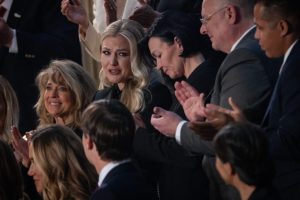
Erika Kirk’s appearance at the 2026 State of the Union quickly became one of the most talked-about moments of the evening — not only because President Donald Trump referenced her late husband during his address, but because of the emotional reaction that followed. As cameras panned to her in the gallery of the United States Congress, viewers watched closely while the president paid tribute to Charlie Kirk, the conservative activist whose death in 2025 shocked political circles nationwide. Within minutes, clips of Erika Kirk standing and appearing to mouth three words spread rapidly across social media platforms, fueling debate and interpretation. In an era when every public gesture is replayed in high definition and analyzed frame by frame, her brief, emotional reaction became symbolic of something larger than a single speech — it became a flashpoint in America’s ongoing political and cultural divide.
On February 24, Trump delivered what commentators described as the longest State of the Union address in modern U.S. history. Speaking before a sharply divided Congress and millions of viewers watching across the country, the 79-year-old president adopted a forceful and confident tone. He praised Republican lawmakers for advancing his legislative priorities, pointed to economic and regulatory achievements from his first year back in office, sharply criticized Democratic opposition, and outlined ambitious plans for border enforcement, energy expansion, and judicial appointments. The address reflected both triumph and tension: triumph for a president touting momentum in his second term, and tension in a chamber where partisan divisions were visible in applause lines and conspicuous silences. The speech was as much a campaign-style rallying cry as it was a constitutional obligation, underscoring the intensity of the current political climate.
At one point, Trump shifted the focus of his remarks to religion and what he characterized as a national spiritual revival. He spoke of renewed faith among young Americans and described what he viewed as a cultural return to traditional values. It was during this portion of the address that he referenced his “great friend” Charlie Kirk, founder of Turning Point USA. Charlie Kirk had been shot and killed on September 10, 2025, while speaking at a Turning Point USA event in Utah — an act that prompted widespread condemnation and renewed concerns about political violence in the United States. His death reverberated deeply through conservative communities and beyond, igniting discussions about security at political events and the increasingly volatile tone of national discourse. Weeks after the tragedy, Erika Kirk assumed a leadership role within the organization, pledging to carry forward her husband’s mission and message.
As Trump honored Charlie Kirk’s legacy during the speech, cameras focused on Erika seated in the gallery above the House chamber. She appeared visibly emotional, dabbing her eyes as lawmakers rose in applause. The president acknowledged her resilience, stating that she had “been through a lot,” and called on Americans to reject political violence of any kind. A widely circulated photograph captured the solemn moment: Erika standing, applauded by lawmakers, framed by the grandeur of the chamber. For supporters, it was a poignant tribute to a fallen activist and a public affirmation of unity against violence. For critics, the moment became intertwined with broader skepticism surrounding the administration’s rhetoric and political posture. Almost immediately, viewers began dissecting her reaction online.
Much of the online conversation centered on a brief clip that appeared to show Erika mouthing the words “I miss you” after she stood. Some social media users described the moment as heartbreaking, interpreting her expression as a raw glimpse of grief unfolding in real time before a national audience. Others questioned whether the reaction appeared rehearsed or performative, reflecting the polarized environment in which even personal loss can become politicized. The phrase itself was never officially confirmed; it emerged from viewer interpretation and lip-reading speculation rather than any verified transcript. Nevertheless, the three alleged words became a trending topic, illustrating how quickly emotional moments can evolve into viral narratives. In today’s digital age, a few seconds of video can eclipse the broader substance of a lengthy presidential address.
Meanwhile, legal proceedings continue in connection with Charlie Kirk’s death. Tyler Robinson, the alleged gunman, faces a capital case related to the shooting, ensuring that the tragedy remains part of ongoing national headlines. Beyond the tribute, the State of the Union highlighted the country’s deep political divisions. Several Democratic lawmakers opted not to attend the address, instead participating in rallies throughout Washington in protest of Trump’s policies. Inside the chamber, tensions were also evident: Representative Al Green of Texas was escorted out after holding up a protest sign as the president entered, marking another contentious episode in an already charged atmosphere. Together, these moments painted a vivid picture of contemporary American politics — emotionally intense, sharply divided, and relentlessly scrutinized. For some, the tribute to Charlie Kirk symbolized unity in the face of violence; for others, it underscored the enduring fractures shaping the national conversation.