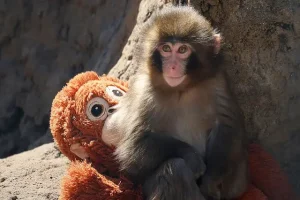
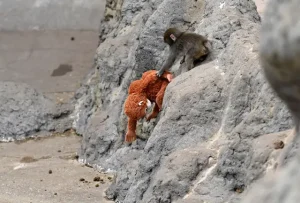
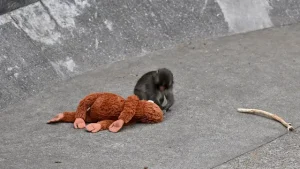
Ichikawa City Zoo has issued a detailed update on the condition of its Japanese macaques, including viral baby monkey Punch, after a surge of public concern over the animals’ appearance and living environment. Punch, who captured global attention after videos showed him clinging to a stuffed orangutan toy for comfort, has become one of the zoo’s most talked-about residents. Born in July last year, the young macaque was rejected by his biological mother shortly after birth and was subsequently hand-reared by zookeepers. Since January 19, he has been living with the main troop, marking an important milestone in his development. While many visitors have delighted in watching his progress, recent social media discussions have shifted toward concerns about his treatment by other monkeys and visible hair loss among several troop members.
Punch’s story first resonated online because of the emotional imagery surrounding his early life. Rejected at birth, he required intensive care from zoo staff, who bottle-fed him and provided constant monitoring to ensure he grew strong enough to eventually integrate with other macaques. His attachment to a plush orangutan toy—used as a surrogate comfort object—struck a chord with viewers worldwide, who anthropomorphized his behavior and rallied around him. However, integration into a macaque troop is rarely seamless. Videos circulating on platforms such as X and Instagram have shown Punch being pushed, chased, or scolded by older monkeys. While some viewers described the behavior as bullying, zoo officials have emphasized that such interactions are typical social corrections within primate hierarchies. According to staff, although Punch has been reprimanded numerous times, no individual monkey has demonstrated sustained or severe aggression toward him.
The latest wave of concern emerged after visitors noticed that several Japanese macaques in the enclosure appeared to be experiencing significant hair loss, or alopecia. In a statement posted on X on Wednesday, February 25, a spokesperson for the zoo addressed these observations directly. The statement acknowledged that increased visitor numbers—many arriving specifically to see Punch—have led to more questions about the animals’ health and the state of the facility. Zoo officials confirmed that a few macaques in the troop do exhibit noticeable hair thinning. However, they stressed that veterinary examinations indicate the monkeys are receiving appropriate amounts of food, maintaining healthy body weights, and showing no signs of underlying illness. According to the zoo, no clear medical disease has been identified as the cause of the alopecia.
Instead, staff believe the primary factor behind the hair loss is excessive grooming behavior within the troop. Grooming is a natural and essential social activity among macaques, reinforcing bonds and establishing hierarchy. However, when grooming becomes overly frequent or concentrated on particular individuals, it can lead to patchy fur loss. Zoo representatives explained that three staff members have been working collaboratively since June 2025 to study the troop’s dynamics and test interventions aimed at promoting healthier group interactions. These measures include environmental enrichment strategies and behavioral monitoring designed to reduce stress and redirect excessive grooming habits. Officials reiterated that the monkeys’ overall health indicators remain stable and that their weight and appetite are within normal ranges according to veterinary assessments.
Beyond health concerns, some critics have questioned the suitability of the “monkey mountain” enclosure itself. Addressing these comments, the zoo stated that animal welfare remains its top priority and that ongoing improvements are continually assessed. Four indoor rooms located behind the public viewing area are permanently accessible to the macaques, providing private retreat spaces away from visitors. Punch, in particular, reportedly uses these hidden areas when he needs rest or distance from the troop. Additionally, the zoo has incorporated trees and climbing structures to encourage natural play and exploration, particularly among younger monkeys. Officials cautioned that making abrupt, large-scale environmental changes could disrupt established social hierarchies and potentially increase stress or conflict, which might inadvertently worsen Punch’s integration process.
In concluding its statement, the zoo emphasized that its immediate priority is ensuring Punch safely becomes a fully accepted member of the troop while gradually enhancing living conditions for all the macaques. Staff underscored that careful observation guides their decisions and that any modifications must balance environmental enrichment with social stability. The spokesperson thanked supporters for their continued interest and concern, framing public engagement as a positive force when grounded in patience and understanding of primate behavior. As Punch continues adapting to troop life, zoo officials say they remain committed to transparency and incremental improvements, asking visitors to maintain their support not only for the viral baby monkey but for the entire Japanese macaque community in their care.