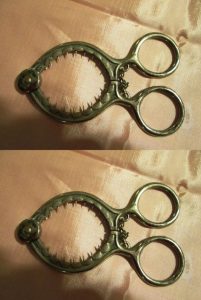
A pearly white, a delicately runny yolk, toast soldiers lined up and ready for dipping—few breakfasts feel as comforting and refined as a perfectly prepared soft-boiled egg. It’s a simple ritual, almost timeless in its charm. Yet anyone who enjoys this morning pleasure knows the most precarious moment comes not in the cooking, but in the cracking. You tap the shell with a spoon. Nothing happens. You tap harder. Suddenly, the shell shatters unpredictably, fragments scatter across the plate, and the once-beautiful yolk spills out prematurely. The calm of the morning is replaced with mild frustration. For something so simple, opening a soft-boiled egg can feel unnecessarily complicated. But there exists a small, ingenious utensil designed specifically to eliminate this tiny daily struggle—one that, at first glance, looks curiously similar to a cigar cutter. It’s unexpected, discreet, and surprisingly satisfying to use.
This clever device is commonly known as an egg topper or egg cutter. Compact and often crafted from stainless steel, it has a slightly vintage aesthetic that makes it feel like an heirloom from a more ceremonious era of dining. Its rounded bell-shaped cap rests gently on top of the egg, while a slender handle or sliding rod sits above it. Though its appearance may puzzle those unfamiliar with it, its purpose is remarkably precise: to remove the top of a soft-boiled egg cleanly and effortlessly without crushing the delicate shell beneath. Unlike knives or spoons, which rely on guesswork and pressure, this tool is engineered for control. It transforms what is usually a messy crack into a clean, circular opening that looks intentional and elegant.
Using it is refreshingly simple. First, you place your freshly cooked egg upright in an egg cup, ensuring it is stable. Then you position the bell-shaped base of the tool directly over the top of the egg. With a gentle lift of the handle—usually attached to a small weighted mechanism—you raise it slightly and let it drop. That small downward motion creates a controlled shock around the rim of the shell. The effect is subtle but precise: a fine, even fracture forms in a perfect circle near the top of the egg. All that remains is to lift off the neatly separated “lid.” No jagged edges, no shell fragments embedded in the white, no risk of piercing the yolk. Just a smooth opening that reveals the golden center inside, ready for dipping.
The brilliance of this tool lies in its understanding of physics. Rather than cutting through the shell like a blade, it generates a quick, evenly distributed vibration that travels around the circumference of the egg’s top. This controlled impact weakens the shell along a single, consistent line. Because the pressure is evenly dispersed, the lower portion of the shell remains intact. The yolk stays undisturbed. It’s a subtle demonstration of how thoughtful design can solve a common problem with minimal effort. What once required careful tapping and hope now becomes a smooth, almost ceremonial motion—lift, release, click. In that satisfying sound lies the promise of a perfectly opened egg every time.
Beyond practicality, the egg topper brings a certain refinement to the breakfast table. There is something quietly impressive about lifting the shell cap cleanly away instead of hacking at it with cutlery. It elevates the experience from hurried weekday meal to deliberate morning ritual. Guests notice it. Children find it fascinating. It adds an element of theater to brunch without requiring culinary expertise. Even those who rarely cook can master it instantly. There’s no special technique, no risk of failure, no complicated instructions. In a world where kitchen gadgets often overpromise and underdeliver, this one performs exactly as intended—with grace and consistency.
What makes it even more appealing is its modest footprint. It takes up very little space in a drawer, yet when brought to the table, it immediately sparks curiosity. Its retro charm feels almost European in spirit, reminiscent of leisurely breakfasts and neatly set tables. It doesn’t clutter the kitchen or demand constant maintenance. A quick rinse is usually enough to keep it clean and ready for the next use. For those who cherish small details—linen napkins, matching egg cups, properly brewed coffee—it becomes part of a broader appreciation for everyday elegance. And for those simply seeking convenience, it quietly delivers efficiency without fuss.
Ultimately, this unassuming utensil restores dignity to one of the simplest breakfast dishes. The soft-boiled egg, often underestimated, becomes an experience again rather than a gamble. No scattered shell shards. No accidental yolk explosion. Just a clean, circular opening that reveals the creamy interior beneath. It proves that innovation doesn’t always mean complexity; sometimes it means refining a small, familiar action until it becomes effortless. Simple, precise, and elegant, the egg topper turns a potentially messy moment into a satisfying ritual. In doing so, it adds a subtle touch of savoir-vivre to the morning—transforming an ordinary breakfast into something quietly extraordinary.