The disappearance of Nancy Guthrie has unsettled her quiet Tucson neighborhood and drawn national attention as investigators work around the clock to understand what happened inside her home on the morning of February 1. Nancy, 84, was last known to be at her residence before vanishing without a trace, and what initially seemed like a welfare concern quickly turned into something far more ominous when authorities discovered blood at the scene. That discovery immediately shifted the case from a missing-person inquiry into a potential violent crime investigation, prompting the involvement of federal agencies and a wider search effort. Days stretched into nearly two weeks with few concrete answers, leaving her family in agonizing limbo and the public desperate for clarity. When the FBI released surveillance footage captured by a Nest doorbell camera, it marked the first time outsiders were able to glimpse a possible suspect connected to the timeline of Nancy’s disappearance. The video, recorded in the stillness of early morning darkness, shows a solitary figure moving near the front entrance of her home. For investigators and observers alike, the footage offered both hope and unease: hope that visual evidence might bring identification, and unease because the person’s clothing and behavior suggested deliberate concealment. What had once been a mystery confined to police reports suddenly became visible, and that visibility intensified the scrutiny. Every frame of the grainy video became a clue to dissect, every shadow potentially meaningful, and every movement a possible indicator of intent. For Nancy’s loved ones, seeing a stranger lurking outside her home only deepened the emotional weight of the situation, transforming the abstract fear of “someone out there” into a concrete image of a masked individual standing where she should have been safe.
Because of those factors, Constantine indicated she does not believe the footage reflects a routine burglary.
The footage itself is brief but striking. The person appears dressed in light-colored clothing, a detail that contrasts with the darkness of the hour, and wears gloves along with a balaclava that covers most of the face. A backpack rests firmly against the figure’s back, and what seems to be a firearm is visible, carried openly rather than hidden. At one point, the individual reaches toward the camera as if adjusting or interfering with it, a gesture that suggests awareness of being recorded. That small act alone has drawn attention because it implies planning rather than chance. Someone who merely wandered onto the property would be unlikely to notice or deliberately manipulate a doorbell camera, whereas someone with intent might prioritize disabling surveillance. The suspect’s posture appears cautious yet purposeful, neither rushing nor hesitating, moving with the kind of focus that raises more questions than answers. Investigators often describe such behavior as “task oriented,” meaning the person seems to be following a specific plan rather than improvising. The presence of a backpack and weapon adds another layer of concern, hinting that the visit may have involved preparation for something more serious than a simple knock at the door. Even so, the video does not show what happened next or whether the individual entered the home, leaving crucial gaps in the narrative. Those missing moments are precisely what investigators now seek to reconstruct through physical evidence, digital traces, and witness accounts.
The note’s alleged closing words — “Time is more than relevant” — have heightened public concern, though officials continue to withhold critical details as the investigation unfolds.
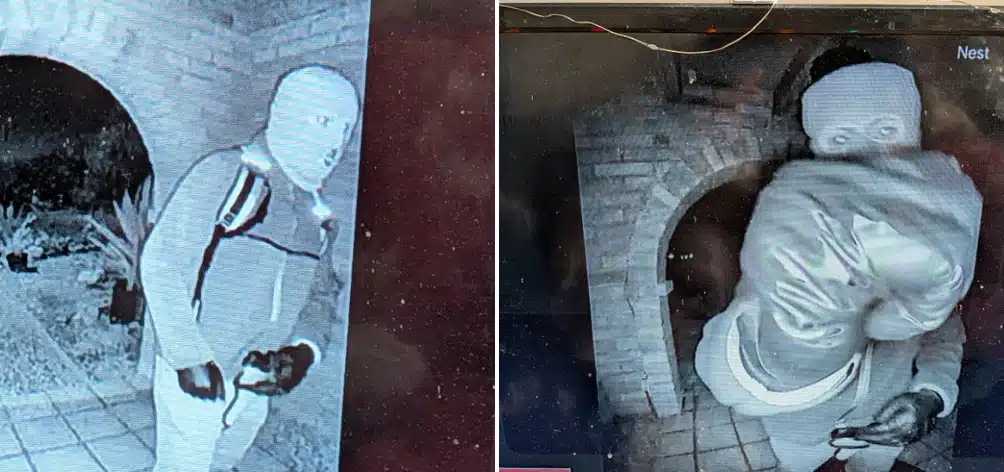
Former FBI agent Mark Harrigan was among the first experts to publicly comment on the footage, and his attention quickly focused on the way the suspect handled the apparent firearm. According to Harrigan, the positioning of the weapon is “very non-conventional,” carried exposed and toward the front of the body rather than secured or concealed. In his experience, individuals familiar with weapons—whether law enforcement, military personnel, or experienced criminals—tend to carry them in ways that maximize safety, stability, and discretion. The awkward or visible placement seen in the video may indicate someone uncomfortable or inexperienced, someone who perhaps does not routinely handle firearms. That observation does not prove anything by itself, but it adds an interesting psychological dimension to the analysis. If the person is inexperienced, the situation could have been chaotic or impulsive rather than professionally orchestrated. Alternatively, the visible carry might have been intended as intimidation or readiness. Harrigan’s comments highlight how investigators interpret not only what a suspect does but how they do it. Subtle details—hand placement, body angle, the confidence of movement—can suggest background, training, or lack thereof. In high-stakes cases, these micro-behaviors sometimes become key leads, helping to narrow the field of possible identities. While the public sees a shadowy silhouette, professionals see a puzzle of habits and tells, each one a thread that might eventually connect to a real person.
Another layer of analysis came from body language specialist Susan Constantine, who examined something many viewers initially overlooked: the backpack. At first glance, it might seem like an ordinary accessory, but Constantine noted that it appeared already full before the individual even approached the house. That detail struck her as inconsistent with typical burglary behavior. In many property crimes, perpetrators bring empty bags or containers specifically to carry stolen items away, and they often operate in teams with assigned roles such as lookout, entry, or getaway driver. Working alone, entering through the front area rather than a side or back entrance, and carrying what seems to be a packed bag does not neatly align with that pattern. To Constantine, those inconsistencies suggest that the suspect’s purpose may not have been routine theft. Perhaps the bag contained tools, equipment, or something else entirely unrelated to stealing household goods. The fact that the person appeared to act solo further complicates the picture, since coordinated burglaries typically involve multiple participants to minimize risk. These observations don’t establish motive, but they push investigators to consider possibilities beyond simple property crime. Was the individual scouting? Delivering something? Removing something? Or preparing for a different kind of confrontation? Each scenario paints a different narrative, and without more evidence, the backpack remains a silent but intriguing clue.
Former CIA officer and FBI special agent Tracy Walder offered yet another perspective, focusing on the suspect’s gait and missing gear. While the average person might see only a blurry walk, trained analysts often study movement patterns the way detectives study fingerprints. The rhythm of a stride, the angle of shoulders, and the way weight shifts from foot to foot can sometimes help identify a person or at least narrow comparisons with known footage. Walder explained that such analysis may reveal whether someone has injuries, specialized training, or distinctive habits. She also pointed out something notably absent: night-vision equipment. For a supposedly planned nighttime approach, the lack of tools that enhance visibility seems unusual. Many organized operations, whether criminal or tactical, involve gear to navigate darkness more effectively. The absence of such equipment could suggest either improvisation or limited preparation. Still, Walder emphasized that these insights are interpretive rather than definitive. Behavioral clues can guide investigations, but they cannot replace concrete evidence. At the same time, reports of a third ransom note have intensified the atmosphere of uncertainty. This latest message allegedly references a different Bitcoin wallet and offers to reveal a name in exchange for payment, adding a digital trail to an already complex case. Authorities have not confirmed its authenticity, and such communications sometimes turn out to be hoaxes, but the note has nonetheless been forwarded to federal investigators for scrutiny. Its cryptic closing line—“Time is more than relevant”—has unsettled many observers, though officials remain careful not to speculate publicly.
For now, the case stands at a delicate intersection of evidence, analysis, and hope. Law enforcement has not identified the person in the footage, nor confirmed whether that individual is directly responsible for Nancy Guthrie’s disappearance. Physical evidence from the home, digital data from devices and cameras, financial trails linked to ransom demands, and expert behavioral assessments are all being pieced together like fragments of a larger mosaic. Families in situations like this often endure a painful waiting game, clinging to the possibility of answers while fearing what those answers might reveal. Nancy’s daughter, Savannah Guthrie, and the broader community continue to call for vigilance, encouraging anyone with information to come forward. Yet officials stress that speculation can hinder rather than help, reminding the public that conclusions must come from verified facts. In high-profile cases, it is easy for theories to multiply, but ultimately only evidence will determine what truly happened on that quiet Tucson morning. Until then, the surveillance footage remains both a clue and a question mark—a brief, haunting glimpse of someone standing where Nancy should have been safe. For her family, every day without resolution feels longer than the last, and their wish remains heartbreakingly simple: clarity, accountability, and above all, Nancy’s safe return.