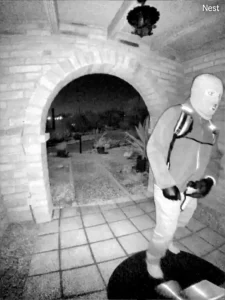
Savannah Guthrie has broken her silence following the release of deeply unsettling images that have intensified fears surrounding the disappearance of her mother, Nancy Guthrie, a case that has rapidly grown from a private family crisis into a national story watched with anxiety, compassion, and concern. The photographs, released by federal authorities after days of painstaking technical recovery, show a masked individual lingering outside Nancy’s Arizona home in the early morning hours on the day she vanished. The figure appears deliberate and cautious, wearing gloves, a face covering, and a backpack, and is seen tampering with the home’s doorbell camera as if attempting to disable or obscure it from view. For Savannah, a seasoned journalist who has spent decades reporting on tragedies affecting other families, the images represented a devastating reversal of roles. Instead of calmly narrating events from behind a studio desk, she is now living through a nightmare viewers could only imagine through her reporting. Speaking publicly for the first time since the images were released, she conveyed a mixture of anguish, strength, and resolve, emphasizing her unwavering belief that her mother remains alive. Her words resonated not only with fear and uncertainty but also with the unbreakable bond between mother and daughter. The public absorbed the visuals as a haunting symbol of how quickly ordinary routines can fracture, how a quiet home can become the center of a criminal investigation, and how unanswered questions ripple outward, affecting not just a single family but a nation watching and waiting for clarity.
The investigation into Nancy Guthrie’s disappearance has unfolded with mounting tension over more than a week, drawing intense media scrutiny and public concern as each day passes without answers. Law enforcement officials revealed that the newly released images were not immediately accessible, requiring technical work involving residual data from the home’s security systems. Investigators indicated that some recording devices may have been removed, damaged, or interfered with, complicating early attempts to reconstruct a timeline of events. The masked individual captured in the footage appears to have acted with forethought, tampering with the doorbell camera in a manner suggesting planning rather than opportunistic crime. FBI Director Kash Patel confirmed that authorities believe the person was armed, deepening fears about Nancy’s safety. Despite extensive neighborhood searches, repeated interviews with potential witnesses, and thorough forensic examinations, investigators have yet to make an arrest or publicly identify a suspect. The Pima County Sheriff’s Department has stated that no additional press briefings will occur unless significant new developments arise, a strategy intended to preserve the integrity of the investigation but one that leaves the family and public in anxious anticipation. The combination of meticulous investigation and public silence has heightened tension, leaving observers to grapple with the unknown while law enforcement works behind the scenes.
Adding another layer of complexity and distress is the mysterious ransom note that surfaced early in the investigation, introducing the possibility that Nancy’s disappearance may have been a calculated kidnapping rather than an isolated act of violence. The note reportedly demanded six million dollars in Bitcoin and specified two precise deadlines, immediately creating urgency and terror for the family. Curiously, the note offered no explanation of the consequences if the deadlines were missed, leaving investigators, the family, and the public to speculate about potential threats. Both deadlines have now passed without verified contact from the supposed perpetrators, fueling further uncertainty. In typical ransom cases, authorities expect continuous communication, negotiations, or proof of life; the absence of such signals has intensified anxiety and speculation. Federal officials cautioned that silence does not indicate a specific outcome, noting investigations often unfold in ways not visible to the public. For Savannah and her family, each hour without news carries a tangible weight, forcing them to confront a torment born not from overt threats but from the oppressive uncertainty that accompanies every unanswered question. Their emotional state fluctuates between hope and dread, clinging to the belief that Nancy remains alive while imagining countless scenarios, some comforting, many terrifying. The psychological burden of waiting in this liminal space, neither confirmed safe nor definitively lost, has become one of the most wrenching aspects of their ordeal.
Throughout the crisis, Savannah has leveraged her public platform to express the immense pain her family endures and to make heartfelt appeals for assistance, urging anyone with information to come forward. In an emotional early statement, she described the family as being in “an hour of desperation,” a phrase capturing both urgency and vulnerability. Her more recent social media post, shared alongside the images, was brief but powerful, reiterating her belief that her mother is alive and pleading for her safe return. The post spread rapidly, prompting an outpouring of support from viewers, colleagues, fellow journalists, and individuals who had never met the Guthries but felt connected through shared empathy. Many praised Savannah for the courage to speak publicly while enduring profound personal anguish, while others expressed heartbreak at seeing someone so familiar facing such a frightening ordeal. Her public statements humanize the case, transforming it from a distant headline into a story of love, fear, resilience, and the stakes involved when someone goes missing. Through her words, the public is reminded that behind every disappearance lies a family grappling with uncertainty and striving to remain hopeful despite relentless suspense and fear. Savannah’s efforts illustrate how a public figure can use visibility to amplify urgent pleas for justice and safety, ensuring the human cost behind headlines is seen.
The circumstances surrounding Nancy Guthrie’s disappearance remain deeply troubling and opaque, intensifying the emotional strain on her loved ones. She was reported missing after failing to arrive at a friend’s home for church on February 1, an absence that immediately alarmed friends and family who knew her as dependable and committed to routine. Those close to her have emphasized that she would never vanish without explanation, reinforcing investigators’ belief that foul play is involved. Law enforcement agencies have conducted extensive searches in nearby neighborhoods and desert terrain, following leads as they emerge, yet no definitive clues have surfaced. At points, public speculation has swirled around individuals connected to the family, including Savannah’s son-in-law, though authorities stress no person of interest has been formally identified. Each rumor or unverified claim adds another layer of stress for the family, who must navigate private anguish alongside relentless scrutiny. The combination of uncertainty, public attention, and the lack of clear leads has made each passing day psychologically taxing, leaving the family caught between hope, dread, and a desperate desire for answers. The sustained pressure highlights the cruelty of unresolved disappearance and the vulnerability high-profile families face when private trauma becomes public.
As the investigation progresses, the release of the images has marked a pivotal and sobering moment, offering the clearest visual evidence that someone may have been present at Nancy Guthrie’s home with malicious intent. For investigators, the photographs provide a potential breakthrough, allowing analysis that could lead to identification through gait, clothing, or connections to other surveillance. For Savannah and her loved ones, however, the images are a chilling reminder of the danger Nancy may have faced and could still be facing. Despite the fear they evoke, Savannah continues to project determination and hope, emphasizing that the search must persist until concrete answers are obtained. Her stance reflects a truth shared by families of the missing worldwide: until definitive proof indicates otherwise, hope becomes a lifeline, sustaining them through unbearable waiting and inspiring belief in the possibility of reunion. The combination of public support, law enforcement diligence, and unyielding familial devotion encapsulates the reality of missing-person cases, where every lead, image, and message carries profound significance. Savannah’s journey through fear, uncertainty, and resilience highlights both the personal and societal dimensions of such tragedies, reminding the public that behind each news story lies enduring human love and the relentless pursuit of safety and justice. Her steadfast advocacy serves as a testament to the power of hope and the extraordinary courage of a daughter confronting the unimaginable.