For more than half a century, Cher has existed in a category entirely her own, defying Hollywood conventions with the same confidence she brings to a stage in sequins and sky-high heels. In an industry that often treats aging like a liability and pressures women to disappear quietly once they pass a certain birthday, she has done the opposite—remaining visible, vocal, and unapologetically present. As conversations around cosmetic procedures, beauty standards, and “natural aging” grow louder across entertainment media and social platforms, Cher’s long-standing candor offers rare context behind the headlines. She has never pretended that time stands still, nor has she claimed to possess some mystical, effortless youth. Instead, she has treated her appearance the way she treats her music and fashion: as something she can shape, experiment with, and control. That attitude—equal parts rebellion and self-ownership—has helped her outlast generations of trends. From black-and-white studio portraits in the 1960s to high-definition red carpets in the streaming era, Cher’s face has been photographed, analyzed, celebrated, and scrutinized more than most celebrities experience in a lifetime. Yet through it all, she has maintained a simple philosophy: her body is her business. As you move through the decades of images—early headshots, television appearances, movie premieres, and award shows—you see not just a changing look but the evolution of a cultural icon navigating fame on her own terms. And in a media landscape obsessed with “before and after” comparisons, her story feels less like a mystery to solve and more like a timeline of choices she has never tried to hide.
In the mid-1960s, before superstardom fully took hold, Cher’s original look was striking in its simplicity and magnetism. Long, inky hair fell straight past her shoulders, framing sharp cheekbones and wide, expressive eyes that seemed made for the camera. There was something unmistakable about her presence even then—a blend of vulnerability and boldness that separated her from the polished pop stars of the era. Early portraits from recording sessions and press conferences show a young woman checking her makeup in studio mirrors, laughing with journalists, and learning how to navigate the machinery of fame. These were the years before cosmetic procedures became tabloid fodder, before every public figure faced microscopic online analysis. The focus was her voice, her chemistry with Sonny, and the fresh, unconventional style that made her stand out. Yet as her profile grew, so did the scrutiny. By the late ’60s and early ’70s, when her career expanded into television and film, the attention shifted subtly from what she created to how she looked while creating it. That shift marked the beginning of a dynamic that would follow her for decades: success paired with relentless commentary about her face, her body, and every perceived change. Still, Cher never seemed to shrink under the spotlight. If anything, she leaned in harder—experimenting with fashion, sharpening her image, and treating beauty like another form of performance art. Even then, the seeds of her later philosophy were visible. She wasn’t trying to preserve some frozen version of herself. She was evolving, adjusting, and embracing the idea that reinvention could be empowering rather than something to fear.
By the late 1970s, Cher had entered what many fans consider her most flamboyant and fearless era, fully embracing disco glamour, theatrical makeup, and jaw-dropping couture from designers like Bob Mackie. Feathered headdresses, sheer gowns, glittering bodysuits—nothing was off limits. Her appearance wasn’t just personal; it was part of the spectacle. At film festivals, fashion shoots, and music conventions, she looked less like a conventional celebrity and more like a living piece of pop art. This period cemented her reputation as a style icon and risk-taker, someone who understood that image could be as powerful as sound. But with peak visibility came amplified curiosity. Every new hairstyle or contour sparked speculation. When she transitioned into more serious acting roles in the early 1980s—earning critical praise and major awards—the conversations intensified. Now she wasn’t only a singer or fashion muse; she was an Academy Award–winning actress, and the industry watched her even more closely. Cosmetic discussions, though far less open at the time than they are today, swirled quietly in magazines and gossip columns. The irony was hard to miss: while male stars aged into “distinguished” status, women were expected to remain perpetually unchanged. Cher, as always, refused to follow that script. Instead of retreating, she continued to show up to premieres and ceremonies in daring looks that practically dared people to talk. Her message, whether spoken or not, felt clear: if people were going to stare anyway, she might as well give them something unforgettable to look at. Reinvention became her signature, and the idea of a single, fixed version of Cher began to feel impossible.
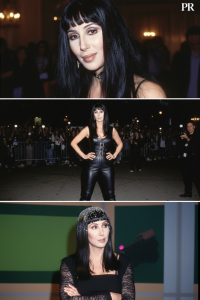
By the 1990s and early 2000s, advancements in cosmetic technology and growing tabloid culture collided, turning celebrity appearances into constant speculation. Photos from album releases, charity events, and red carpets showed a smoother, more sculpted look that fueled increasingly dramatic rumors. Rather than ducking the conversation, Cher did something rare—she addressed it directly. In interviews, including a widely remembered Primetime appearance, she acknowledged having plastic surgery while pushing back against exaggerated claims. She spoke with humor and defiance, insisting that while she had made adjustments, the tabloids had turned her into a science-fiction project of imaginary implants and impossible alterations. Her now-famous comments—equal parts blunt and rebellious—cut through the noise. If she wanted to change something, that was her choice, and she refused to treat it like a confession. She also explained that she’d never hidden earlier procedures like her nose and teeth because it simply hadn’t occurred to her that they should be secrets. That transparency reframed the entire narrative. Instead of whispering or denying, she normalized the idea that cosmetic work could be just another personal decision. Around the same time, cosmetic injectables like Botox and fillers were becoming more widely available, and experts later speculated that her refreshed look aligned with those industry developments. Whether or not every guess was accurate almost didn’t matter. What stood out was her attitude: practical, unsentimental, and refreshingly honest. She wasn’t chasing youth so much as maintaining the image she felt comfortable presenting to the world—a professional choice as much as a personal one.
Through the 2010s and into the 2020s, Cher continued to defy expectations simply by staying active. While many of her peers slowed down or disappeared from the public eye, she kept touring, performing, and attending major events with the same electric presence that defined her early career. Golden Globes, film premieres, fashion galas, music festivals—she remained a fixture. And with every appearance, fascination with her looks resurfaced. Headlines speculated, fans debated, and photos circulated side by side with captions asking how she did it. Yet her own comments suggested a far simpler mindset. In later interviews, she described herself with characteristic wit as the “poster girl for plastic surgery,” acknowledging a facelift while shrugging off the drama around it. Aging, for her, wasn’t a crisis to solve but a fact to navigate. She talked about keeping friends of all ages, staying curious, following trends, and relying on good genes as much as anything else. Perhaps most telling was her refusal to pretend she was trying to be younger. “I am who I am,” she said, a line that feels like the thesis of her entire career. There’s something powerful about that steadiness. In a culture obsessed with anti-aging products and miracle transformations, she offers a different narrative: one where experience, style, and self-knowledge matter more than pretending the clock doesn’t tick. At 79, she still steps onto stages in front of thousands, still jokes with reporters, still commands attention without asking for permission. It’s less about defying age and more about refusing to let age dictate the terms of her life.
Recently, technology has added yet another layer to the conversation. AI-generated images imagining what Cher might look like without any cosmetic enhancements have circulated online, showing deeper lines, softer contours, and more pronounced signs of aging. These speculative portraits create an intriguing contrast with her real-life photos, inviting viewers to compare “natural” aging with her chosen path. But the exercise also raises a bigger question: why is there such pressure to imagine an alternate version of her at all? In many ways, the comparison misses the point. Cher never claimed to age without assistance, never sold an illusion of untouched youth. What she has consistently offered is ownership. Whether through real photographs or digital projections, her story isn’t about proving what is authentic; it’s about asserting autonomy. Her face, like her career, is a series of deliberate decisions—each one reflecting the era, the technology, and her personal comfort. That honesty may be her most radical trait in Hollywood. Instead of apologizing, she shrugs and keeps going. Instead of hiding, she speaks plainly. Decades after her first portrait, she remains unmistakably herself: bold, funny, a little rebellious, and completely uninterested in following anyone else’s rules. In the end, that’s what makes her enduring. Not flawless skin or perfect lighting, but the confidence to say, essentially, this is me—take it or leave it. And for generations of fans, that unapologetic authenticity is far more compelling than any wrinkle ever could be.